
Assessing how LEO satellite could be a cost-effective broadband option to serve remote and rural areas of Europe

“Analysys Mason's research was instrumental in demonstrating LEO satellite's role as a cost-effective solution for universal connectivity. Their comprehensive analysis provided the evidence base that became a cornerstone of our advocacy for recognizing LEO satellite technology in the EU's Digital Decade and national broadband strategies”
– Jordi Casanova, Head of EU Public Policy – Telecoms and Space, Amazon

The challenge
Amazon needed to explore whether low-Earth orbit (LEO) satellite could be used to fill coverage gaps within the hard-to-reach areas of European Union (EU) Member States
The European Commission’s latest update on its Digital Decade goals signalled that the EU was unlikely to meet its 2030 targets for nationwide gigabit capable broadband through conventional fibre-to-the-home (FTTH) or data-over-cable-service-interface-specification (DOCSIS) upgrades alone, particularly in rural and hard to reach areas. In this context, Amazon sought to understand whether commercially offered LEO satellite services could serve as a viable complement to FTTH in seven representative EU countries that sufficiently address consumer demand for bandwidth. The objective was to assess where LEO satellite services could be more cost effective than FTTH deployment and quantify the funding gap for fibre coverage in areas where fibre is not commercially viable and where LEO satellite can effectively address demand.
Our approach
We combined satellite capacity and cost modelling with detailed fibre cost analysis to compare the cost effectiveness of LEO satellite and FTTH in remote and rural areas
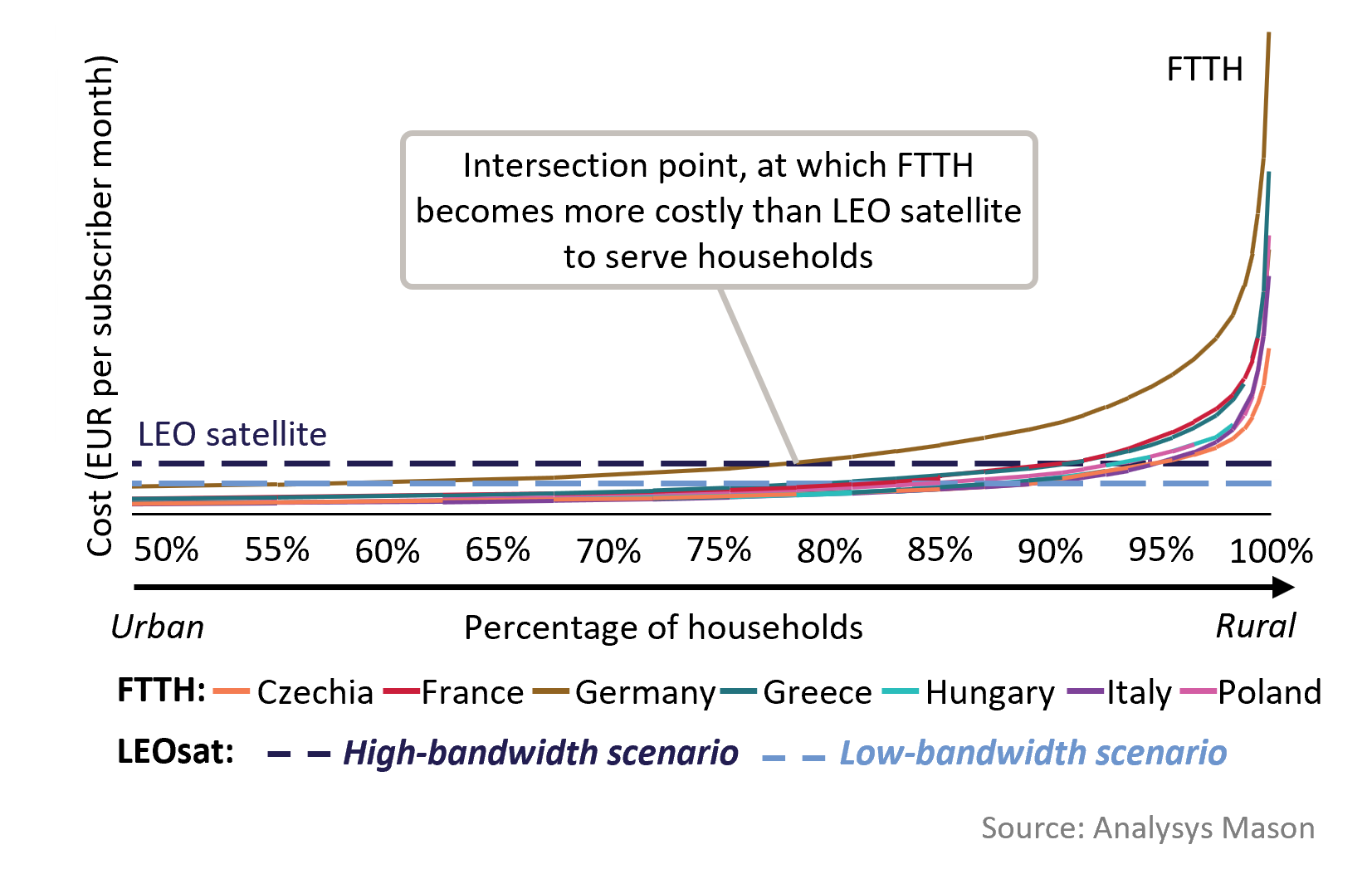
We began by estimating how many customers across seven representative EU countries could realistically be served by the LEO satellite capacity expected to be available by 2030, using US Federal Communications Commission (FCC) constellation filings and our proprietary NCAT tool. We then modelled the cost of a typical LEO constellation by drawing on industry benchmarks and public data to determine an indicative cost per subscriber for LEO broadband. In parallel, we built a detailed, bottom-up geoanalysis-based cost model for nationwide FTTH roll out, calculating the cost per subscriber across different rurality levels in each country. Bringing these together, we estimated the share of households that could be served more cost effectively by LEO satellites in different bandwidth scenarios. We estimated how much of the potential funding gap for FTTH roll-out could be addressed using the expected capacity from announced LEO satellite systems by 2030.
Figure 1: Comparison of estimated cost to deploy and operate an FTTH network against LEO satellite, by household density (final 50%), 2025
The impact
Our analysis found that serving the most remote areas with LEO satellite could provide high-speed broadband to households in a cost-effective and timely manner
Our study found that, while FTTH remains a good choice for the majority of households, using LEO satellite capacity to serve the most remote households in Czechia, France, Germany, Greece, Hungary, Italy and Poland could help close more than EUR20 billion of the funding gap associated with nationwide FTTH roll-out (before factoring in other alternative technologies such as fixed-wireless access or pre-existing FTTH network coverage in rural or remote areas). These findings highlighted LEO satellite as a compelling complement to FTTH and other technologies for extending high-speed connectivity in a cost-effective and timely manner. Our findings were published in a white paper on Amazon’s website. We also presented our findings at two industry forums.

Alexander Ohlsson
PrincipalRelated items
Article
Beyond bandwidth: why policy makers must shift their focus from speed to experience
Article
Strategic ecosystem alignment will fuel growth in the satellite-enabled connected car market
Report
Submarine cable security and resilience