
China Unicom’s Tone Tone shows how embedding network-delivered AI can result in mass adoption
19 December 2025 | Research and Insights
Article | PDF (4 pages) | Customer Engagement | AI | Digital infrastructure
"Network-delivered AI offers operators an edge, but they must simplify the user experience to turn technical complexity into a seamless daily utility."

Generative and agentic AI are evolving at remarkable speed, but adoption still lags behind expectations. The promise of AI remains unfulfilled, not because the technology is not powerful enough, but because it is often too fragmented or complex for users to engage with. Indeed, for many, AI still feels like a tool reserved for specialists rather than an integral part of daily life.
One of the most effective ways to address this issue is to embed AI directly into the devices that people already use. Making AI more intuitive and widely accessible helps to lower the entry barriers for groups that have traditionally been left behind, such as the elderly, while also opening up new possibilities for seasoned digital users.
China Unicom’s AI assistant, Tone Tone, developed on Huawei’s AI Service Function (AISF), is a compelling example of this approach. Tone Tone represents a shift towards device-agnostic, network-delivered AI assistance, and blends agentic capabilities with seamless accessibility and robust security.
Tone Tone integrates more than 30 AI capabilities across consumer services and network functions
All of Tone Tone’s features can all be accessed via a single conversational interface within a mobile application, thus removing the need to switch between tools and menus. Tone Tone offers a wide range of features, including lifestyle services, home management, travel planning, emotional companionship and network optimisation (Figure 1). In the back end, the assistant orchestrates these capabilities dynamically based on user intent. This means that Tone Tone pulls together the required AI capabilities when a user makes a request, without requiring manual input or app-hopping. The result is a smooth, natural experience that feels less like operating technology and more like having a conversation.
Figure 1: Example use cases for Tone Tone
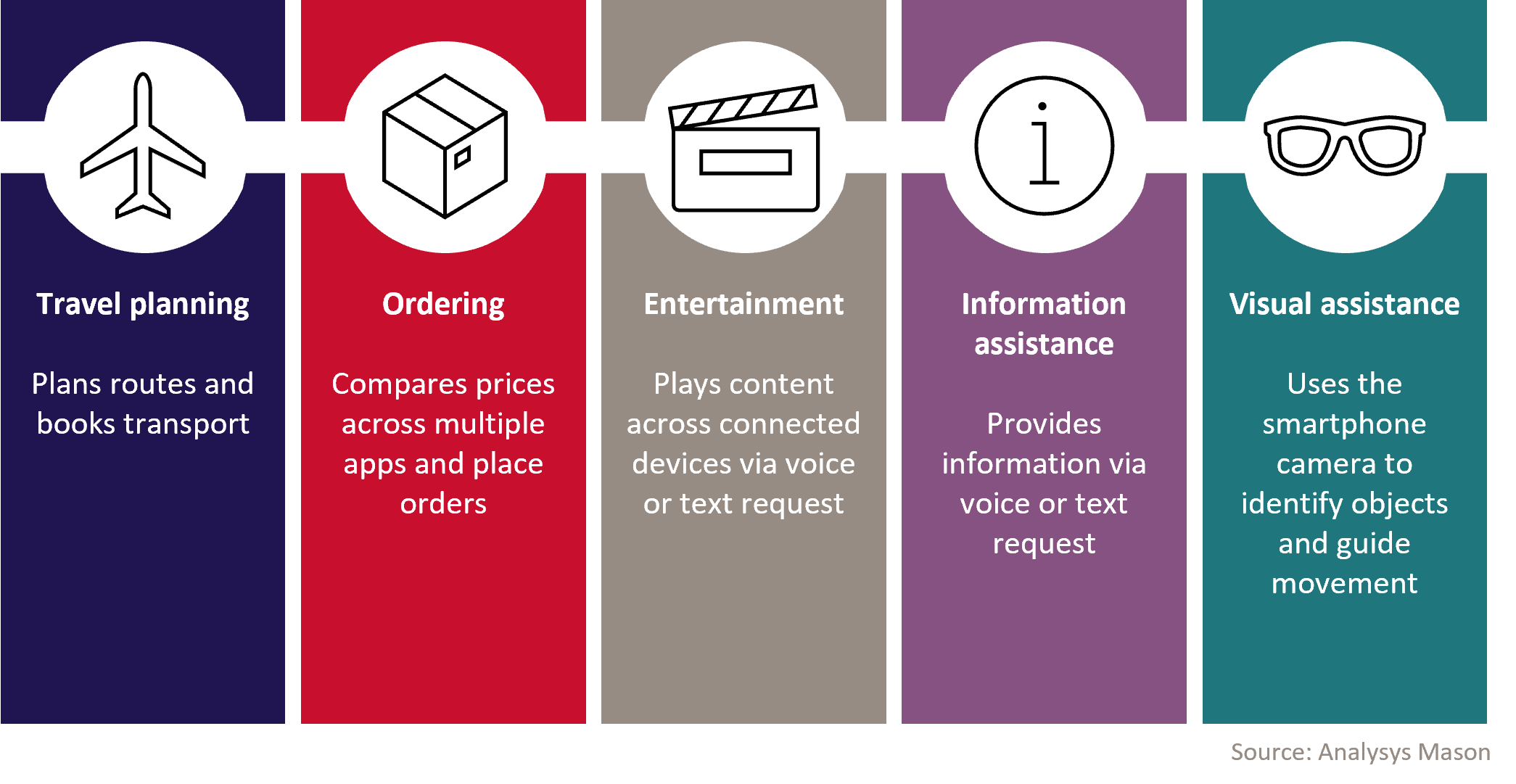
This unified approach is particularly useful for users that are not tech savvy or who face physical challenges, such as visual impairment. Indeed, Tone Tone shows how AI assistants can empower everyone, regardless of their level of digital proficiency, by removing complexity and focusing on conversational engagement.
Users can interact with Tone Tone via natural-language voice commands, the smartphone camera or text input; responses are delivered in either voice or text format. For example, a user travelling to the airport could ask Tone Tone for help with getting to their destination, and Tone Tone would determine the best route and book the required transport, such as a taxi. If the user is visually impaired, Tone Tone could also use the smartphone camera to recognise a vehicle’s licence plate and provide step-by-step walking guidance to locate said taxi. Once at the airport, the user could switch to text-based interactions to request information such as travel details and flight updates.
In these scenarios, Tone Tone operates as an execution layer rather than a traditional chatbot; it completes multi-step actions for the user, rather than simply returning information or guidance alone. This shifts the role of the AI assistant into a day-to-day interface that supports users across everyday activities, independent of their technical ability. It also enables operators to engage customers in a more continuous and context-aware manner.
Tone Tone uses AISF’s network-delivered AI architecture to address the current limitations of terminal-based AI agents
AISF’s architecture delivers AI capabilities via the network itself, rather than operating within the limits of a single phone, app or smart terminal. This means that key functions such as intent processing and memory and security controls are managed centrally, thus enabling Tone Tone to deliver a unified experience across multiple devices and contexts. Figure 2 summarises the observed KPI improvements in AI agent performance as a result of AISF deployment.
Figure 2: AI agent performance before and after the deployment of AISF
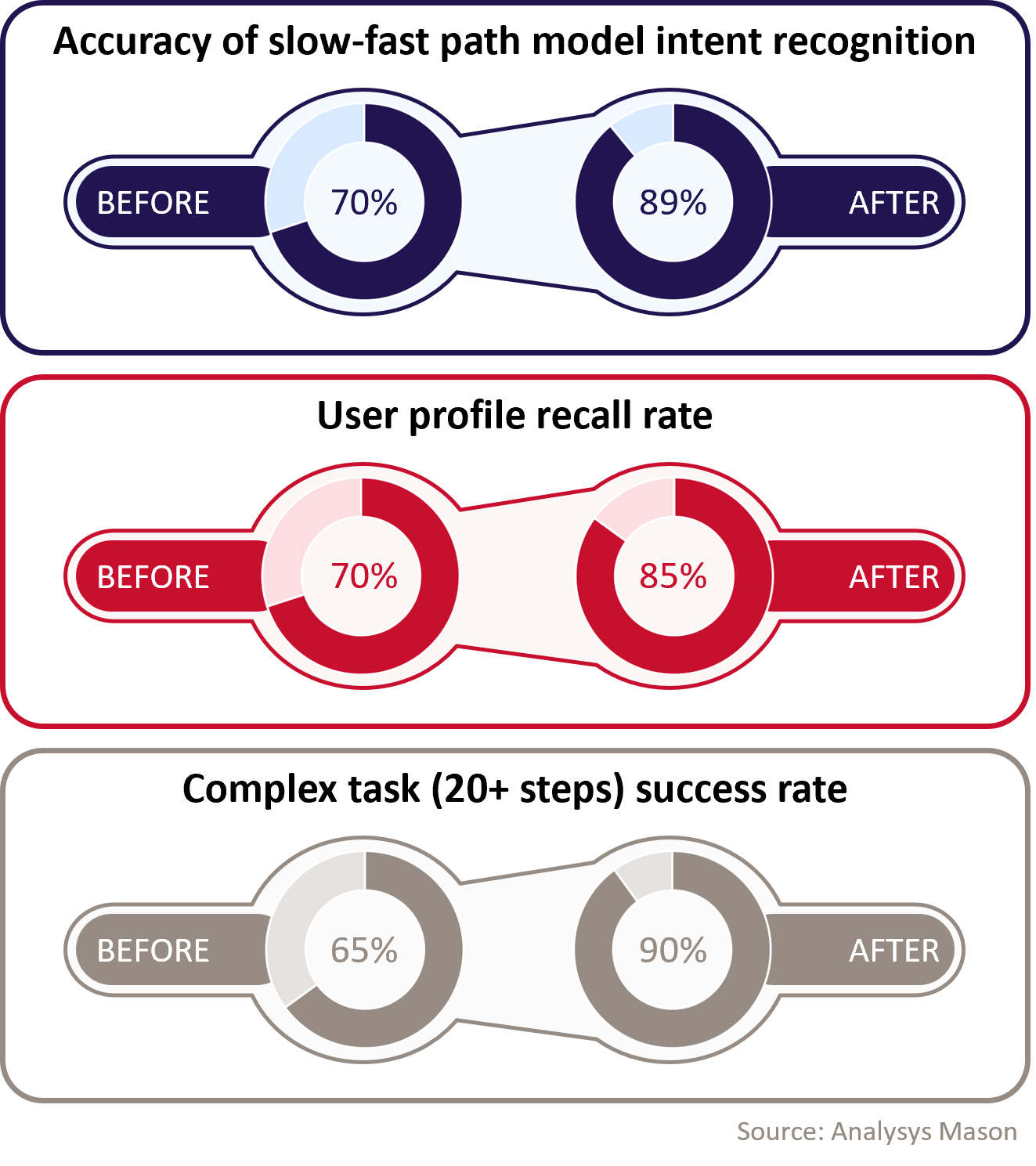
One particularly novel feature is how user memory is managed across devices. Traditional, terminal-based AI models often fragment user data because memory and preferences remain locked within individual devices or applications. By contrast, AISF manages user memory at the network level, thus preserving continuity wherever the user interacts. As a result, Tone Tone can recall prior activities, preferences and context across devices in real time, thereby eliminating the need to retrain or reconfigure with every switch.
In order to achieve this, AISF employs intent recognition to task complexity. Simple requests are solved using lightweight models that are capable of millisecond-level responses. For more involved tasks such as travel planning or multi-step automation, the system activates deeper reasoning pathways that use both contextual memory and decision-based execution.
Security and trust are critical given that Tone Tone executes actions autonomously and handles personal data. AISF addresses this by linking actions to a verified user identity via a SIM-based digital identity, thus minimising the risks of unauthorised control or agent impersonation. It uses end-to-end encryption during both storage and transmission to further protect user data. Importantly, personal memory is only accessed for user-approved tasks to ensure that control over how personal data powers the AI experience remains with the user.
AISF plans to extend AI interoperability across wearables, vehicles and other connected devices
China Unicom launched Tone Tone in March 2025; the service has since gained 13 million cloud smartphone users and 3 million household users. The operator’s Net Promoter Score (NPS) among cloud phone users has risen from 70 to 77 since the launch, while its overall user satisfaction has increased by 8% to reach 89%.
AISF is now extending its reach as a result of this early success. The next evolution lies in building AI interoperability across a wider range of connected devices to enable tasks to transition seamlessly between smartphones, wearables, home systems and vehicles.
Success will depend not only on intelligence but also on reliability, reach and effortless continuity as AI shifts from being an occasional tool to an ever-present companion. Tone Tone’s rapid adoption hints at a future where AI is not something people log into, but rather simply part of how they live and interact every day.
Disclaimer: This article was commissioned by Huawei. Analysys Mason does not endorse any vendor’s products or services.
Article (PDF)
DownloadAuthor

Justin van der Lande
Research DirectorRelated items
Article
Telecoms operators push ahead with building data foundations for AI, but much progress is still needed
Report
Submarine cable security and resilience
Client project
Building a corporate strategy to achieve over 20% revenue growth, diversify the portfolio beyond core telecoms and harness AI-driven value creation