
Operators will progress from GenAI-based agents to agentic AI systems in pursuit of true autonomy
"Operators will persist with agentic AI as long as it promises to fulfil their desire for autonomous networks and operations, but progress could stall if investments do not yield expected outcomes."

The deployment of agentic AI systems1 in telecoms operations is on the horizon. Early efforts have centred on customer service, network optimisation and enterprise-focused AI agents (NTT Docomo’s Smart AI agents). Current agents react to human prompts and have boosted employee productivity and customer experience. However, most of these agents cannot operate complex multi-task systems autonomously. The next breakthrough will arrive when agentic AI deployments can automatically detect user intent (without relying on user input) and when they can execute complex, dynamic and multi-step tasks within telecoms systems. The framework needed to create these systems is not fully developed, but 2026 will be the year when advanced operators start laying the foundations for true autonomous agentic AI systems.
Agentic AI deployments are not yet truly autonomous
Operators’ AI agents are mostly GenAI-based agents that are built around large language models (LLMs). LLMs can receive natural language inputs, process them sequentially to deduce user intent and then generate output or execute tasks (using other tools) that align with the intent. They are also positioned as providing the reasoning and planning capabilities required to execute tasks. However, they are not able to trigger automated workflows without human input (text, images, voice etc). They also lack deep reasoning capabilities and have limited capacity for short- or long-term memory to understand context and recall past events on their own. Consequently, they are not built for autonomous tasks that require complex decisions, multi-step co-ordination or the ability to reassess outcomes based on past events. LLMs’ reliance on the statistical patterns associated with their training data limits their value in performing some telecoms-specific workflows where deep contextual understanding (based on real-time data) is required to run critical operations. At best, LLMs should be viewed as one piece of a larger system, working alongside other components to fulfil autonomous tasks.
Operators will continue their pursuit for truly autonomous agentic AI systems
Going into 2026, we expect operators to begin to trial and deploy advanced agentic AI systems which, unlike LLM-based agents, can operate autonomously.2 These agentic AI systems:
- can be triggered by events (driven by machine learning models in monitoring or predictive AI systems for example)
- will involve multiple agents, collaborating under the control of an orchestrator agent with the ability to plan and co-ordinate complex multi-step tasks.
These systems will transform processes such as network management, which requires continuous monitoring of radio, transport and core networks, and may need specific actions to be executed based on identified events. Human oversight will still be required in some scenarios to validate agentic decisions before execution.
These agentic AI systems are backed by several other components that will support robust reasoning and decision-making, needed for the execution of multi-step processes. Several operators and vendors claim to be operationalising these multi-agent systems including China Mobile, Deutsche Telekom (DT), Huawei and ZTE. DT’s RAN Guardian, for example, involves multiple agents working together to perform complex tasks. We expect more operators to make similar moves.
The shift from LLM-based agents to these advanced agentic AI systems will create demand for vendor offerings that include the architectures required to support them. The key components of these offerings are additional to existing elements used in creating LLM-based agents (Figure 1).
Figure 1: Key components of vendor offerings for autonomous agentic AI systems
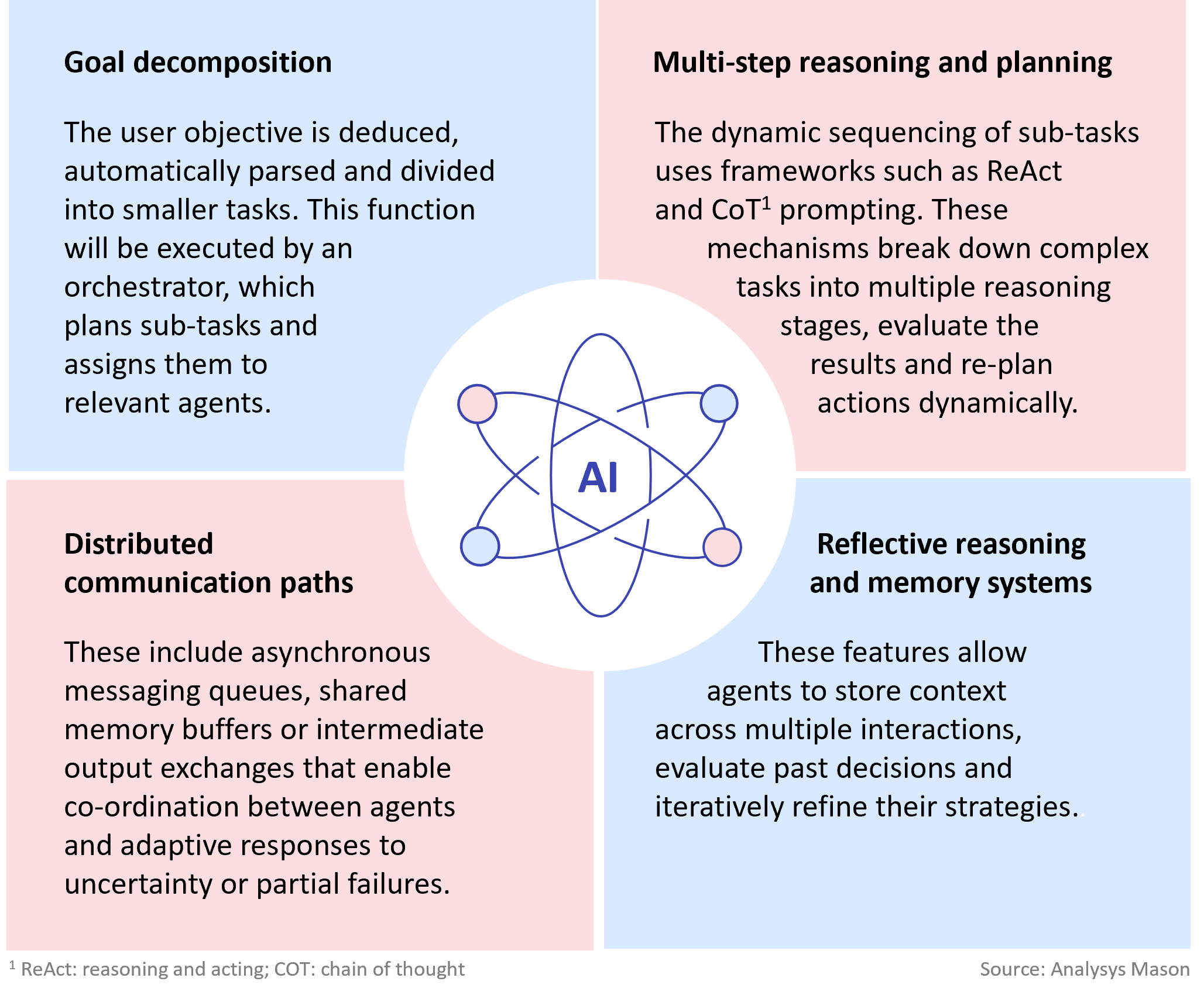
In 2026, telecoms vendors will roll out AI agent development tools with access to frameworks and resources such as LangGraph, AutoGPT and MetaGPT. These advances will address some of the concerns associated with LLMs, enhancing vendors’ agentic AI offerings so that they can support autonomous agentic AI systems.
The pursuit of autonomous agentic AI systems comes with challenges
The path towards autonomous agentic AI systems is neither smooth nor certain.
There are unresolved challenges over non-standardised architectures for creating these autonomous agentic AI systems. Several vendors have launched agentic AI frameworks specific to the telecoms environment, but there are differing views on how to achieve the functions covered in Figure 1.
Concerns over trust, explainability, transparency, reliability and security must be addressed. Maintaining the reliability of these agentic AI systems is paramount, as actions they take will affect millions of telecoms customers. The fidelity of their actions must therefore be guaranteed to preserve customer experience and safeguard the operation of critical infrastructure.
The challenge of monitoring and interpreting the actions of individual agents becomes more pronounced in agentic AI systems, as it requires the behaviour of multiple agents to be evaluated simultaneously. This will be further aggravated by the lack of transparency in agent workflows. The distributed and autonomous behaviour of agentic AI systems is already raising governance and ethical concerns, especially in terms of bias, fairness and accountability.
Operators looking to adopt autonomous agentic AI systems must be ready to address these challenges. They need to work together, through standards organisations such as the TM Forum, to define a common architecture for implementing autonomous agentic AI agents. Individually, operators need to ensure that their agentic AI systems draw from the latest real-time data. They should look to deploy quality-control mechanisms such as inter-agent evaluations to ensure agents review each other’s outputs before executing their functions. Audit trails, observability and explainability pipelines will be important to ensure safety and compliance with regulations. With these capabilities, operators will be well on their way to realising their ambitions for autonomous operations.
1 Agentic AI systems are autonomous AI systems that can make decisions and take actions to achieve goals with minimal human intervention. They do not rely mainly on LLMs to trigger their workflows but can work based on triggers from other AI models such as machine learning models.
2 By autonomous, we mean systems that can operate independently without relying on user input to initiate the agentic workflow.

Author

Adaora Okeleke
Principal Analyst, expert in AI and data managementRelated items
Article
Telecoms operators push ahead with building data foundations for AI, but much progress is still needed
Client project
Building a corporate strategy to achieve over 20% revenue growth, diversify the portfolio beyond core telecoms and harness AI-driven value creation
Client project
Developing a go-to-market strategy and a first-of-its-kind business case for an Asian telecoms operator’s entry into the GPUaaS market