
Beyond bandwidth: why policy makers must shift their focus from speed to experience
02 April 2026 | Regulation and Policy, Strategy
Article | PDF (5 pages) | Fixed Services | Digital infrastructure
“Quality of experience metrics matter because they translate network behaviour into satisfaction and trust.”

For two decades, policy makers’ focus on digital connectivity has been driving the deployment and take-up of full-fibre networks (fibre to the premises, or FTTP). That battle is not yet fully won (some rural areas are still waiting for coverage) but a growing share of end users worldwide can now enjoy service unencumbered by bandwidth constraints. For those with full fibre, quality issues in the fixed access network are largely solved, but some problems may remain in how they experience digital services in practice. Our consumer research shows that the roles of in-home Wi-Fi and also in-network content delivery are becoming more important for full-fibre users.
Policy makers, including regulators and governments, should not assume that faster networks automatically deliver a good digital experience. Since issues will vary by the requirements of individual users and their applications, the thinking must shift from network-centric quality of service (QoS) to user-centric quality of experience (QoE).
While some QoE indices exist, there is no consensus on how to measure QoE. Policy makers must develop a new toolbox to continue to promote competition and innovation and ensure that the digital elements of our critical national infrastructure deliver on their full economic, social and environmental potential.
QoS is out; QoE is in
QoE goes beyond network-focused metrics to reflect real-world user perception. Unlike QoS, which gauges technical connection health, QoE measures outcomes at the application, device and user level. A comparison of the concepts of QoS and QoE is shown below. For end users, QoE issues are tangible: buffering frequency, stream start delay, visible video artefacts, dropped or unclear calls, unresponsive cloud applications or gaming lag. These matter because they translate network behaviour into satisfaction and trust. The challenge is creating a framework that links subjective experience to objective, standardised metrics, enabling network providers and regulators to express QoE in relatable terms.
Figure 1: A comparison of the concepts of QoS and QoE
| QoS | QoE | |
| Key questions answered | How well is the network performing? | Is the service experience good enough for the user’s needs? |
| Definition | Measures the technical performance of the network and connectivity service | Measures how end users actually perceive and experience digital services |
| Focus area | The network and its components; network centric | The user, the application and the device in real-world conditions; end-user centric |
| Typical metrics | Bandwidth, latency, jitter, packet loss, availability | Video start delay, buffering frequency, visible artefacts, call clarity, gaming lag, application responsiveness, satisfaction |
| Points of measurement | Access and core network layers | Application, device, home Wi-Fi and service delivery chain |
| Sensitivity to context | Largely context agnostic, with common thresholds across use cases | Context dependent; acceptable performance varies by application and user need |
| Standardisation and maturity | High; long-established and widely understood metrics | Lower; fragmented approaches and multiple proprietary indices |
Source: Analysys Mason
The key priority now is the experience of the end user. Critically, the desired perceived experience will vary by the group of end users and their current role or needs: the requirements of a competitive gamer will be different from those of a remote professional or telehealth patient.
The focus must shift to either end of the network value chain
As high-quality fibre is deployed in the access network, the focus should shift to the start (source of the content) and end (final connection to the end user) of the network value chain.
Content delivery networks (CDNs) represent the source of most of the content consumed over the internet, and user experience is strongly influenced by the location of the relevant CDN cache server. The closer the server to the end user, the better the experience, in terms of latency and consistency of delivery. CDN strategy continues to move towards deep integration of servers inside ISPs’ networks. This transition from remote, centralised distribution to proactive and predictive local caching allows most content requests to avoid upstream bottlenecks. The results are tangible: content loads and starts more promptly, interactive applications respond without delay, and services are delivered with fewer interruptions and at higher overall quality.
Figure 2: Overview of network dynamics which affect QoE in a world of full fibre
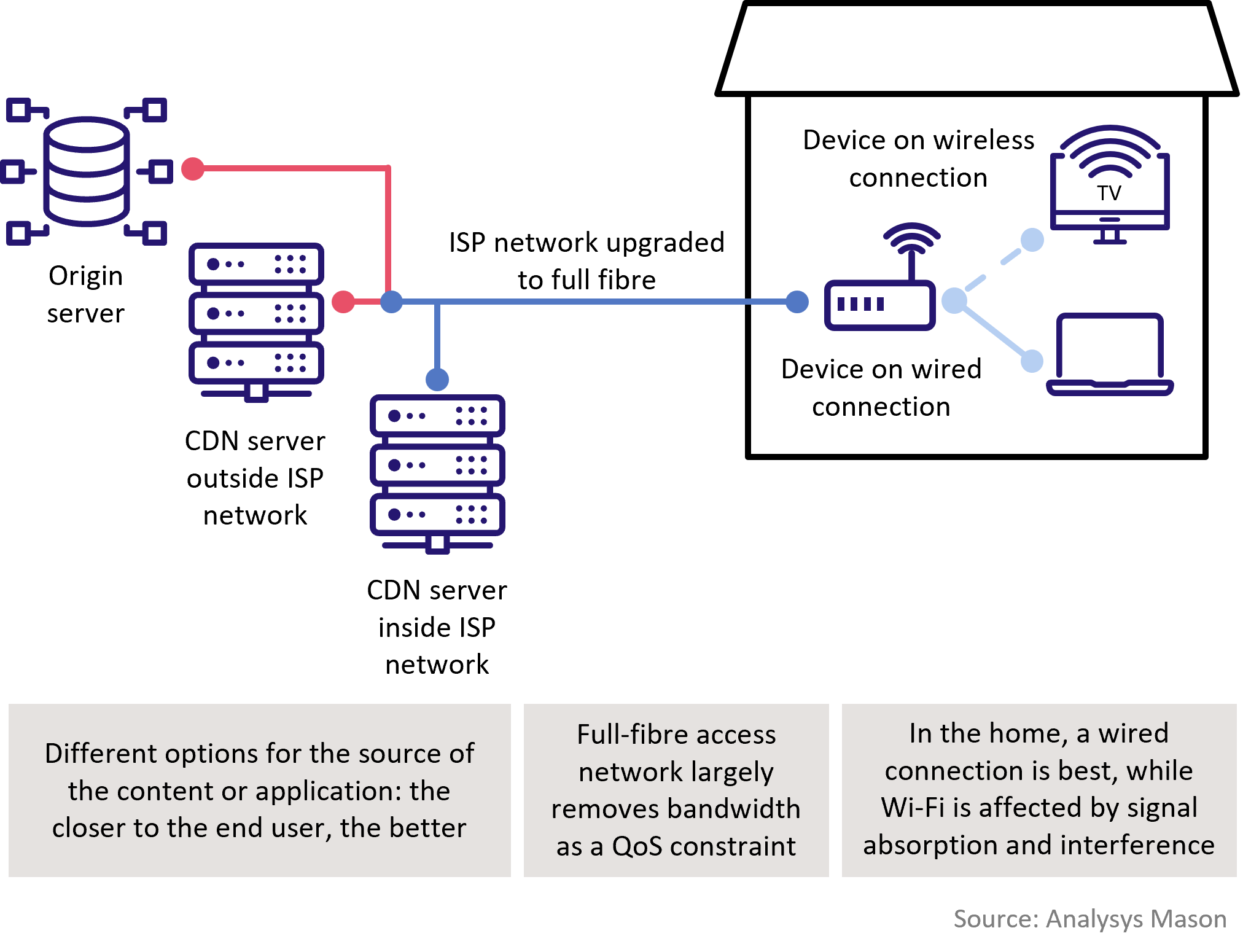
Full fibre and an effective distribution strategy bring the content stream to the doorstep, but the final element of QoE is won or lost in the ‘last metre’: getting to the device.
Ultimately, without ‘wired’ connections in the home, an abundant fibre pipe is only as effective as the final Wi-Fi link to the end user. As bottlenecks created by the external network are removed, the factors affecting Wi-Fi performance – including environmental interference, signal absorption and the complexities of mesh architecture – become the new limiting factors for QoE.
To address these developments, performance metrics must shift away from abstract measures of access network speed towards edge-aware key performance indicators (KPIs), such as the number of end-user devices operating below critical performance thresholds or suffering from latency under load. Without an effective framework to measure and mitigate in-home issues, operators may not be incentivised to proactively address Wi-Fi problems, and the promise of ubiquitous high-speed connectivity will remain, for many users, a promise undelivered. This is further complicated by the in-home devices being owned and managed by the end users, meaning they are not the responsibility of the ISP (even if they are critical to user satisfaction).
QoE measures exist, but they are fragmented
Defining a single, standardised framework for QoE would improve its management, thus enabling a common understanding between all stakeholders, including end users, network/service providers and policy makers.
QoE standardisation is challenging because:
- end-user experience varies by device, Wi-Fi and home set-up, and network and local market factors
- service requirement thresholds differ – what is acceptable for streaming may fail for gaming; some applications adapt dynamically to network conditions and some do not
- some vendors and service providers are developing proprietary QoE indices – while standards like TR 452/QED exist, no universal method converts technical metrics into a single consumer-facing score.
This lack of consensus creates a diagnostic blind spot where stakeholders struggle to distinguish between access network faults, in-home Wi-Fi congestion and application-layer issues. For policy makers, the challenge is no longer just demanding more data, but harmonising it into a transparent framework that applies to the whole value chain and accurately reflects the ‘smoothness of the journey’ rather than just the ’width of the pipe’.
In markets characterised by wholesale arrangements, responsibility for delivered QoE is distributed across multiple parties. Without shared diagnostic frameworks and common attribution models, this creates friction across the value chain. Stakeholders struggle to agree on the source of performance degradation, undermining trust and increasing the cost of resolution. From a policy perspective, this matters because regulatory regimes that focus solely on access network metrics risk misaligning incentives, penalising effective infrastructure investment while failing to address the true drivers of user experience.
As networks mature, policy makers must therefore consider not only what performance is measured, but how responsibility and evidence are distributed across increasingly complex digital ecosystems.
A new toolbox is needed for regulators and other policy makers
Operators and vendors are starting to shift their propositions from service to experience, but policy makers need new tools to make sure they can stay abreast of these developments to effectively shape the market.
To fulfil their mandate of promoting effective competition and maximising consumer benefits, policy makers should make a shift from monitoring peak speeds to establishing ‘experience-first frameworks’ that measure application readiness. This could include latency under load for telehealth or jitter thresholds for cloud gaming.
Policy makers could consider the following actions:
- develop a better understanding of ‘real-world’ end-user needs for application or service performance
- achieve a clearer view of in-home and in-workplace network environments
- facilitate cross-industry standardisation initiatives that harmonise data from disparate sources, moving the market away from proprietary measurement silos towards interoperable standards
- encourage co-ordination between ISPs and major content providers to optimise local caching
- reimagine consumer transparency codes: moving beyond the ‘up-to’ speed promise towards ‘real-world experience’ labels that account for in-home Wi-Fi health and a holistic view of network bottlenecks.
In this way, policy makers can ensure that the full-fibre era delivers on its promise of genuine societal and economic transformation.
Analysys Mason has extensive experience in the technical, economic and policy challenges involved in delivering quality services and user experience over digital communications networks. Please contact Andrew Daly or Martin Scott to explore these themes further.
Article (PDF)
DownloadAuthors

Andrew Daly
Principal, expert in strategy, regulation and policy