
Telecoms operators push ahead with building data foundations for AI, but much progress is still needed
"Telecoms operators have begun deploying data platforms but must resolve existing operational and business challenges to ensure successful modernisation."

Telecoms operators have begun to lay the data foundations for their AI initiatives, but many still struggle to unlock the value of early deployments, as they remain tied to legacy business operating models. The next 5 years will be decisive. Operators that modernise their data architectures, strengthen their governance practices, and partner with data-platform vendors that have deep telecoms expertise will be best placed to scale AI’s value across networks and operations.
This article is based on our recently published Telecoms operator data platform adoption 2025: survey results and analysis. It draws on insights from senior-level executives from top Tier 1 and Tier 2 mobile-only or converged telecoms operators.
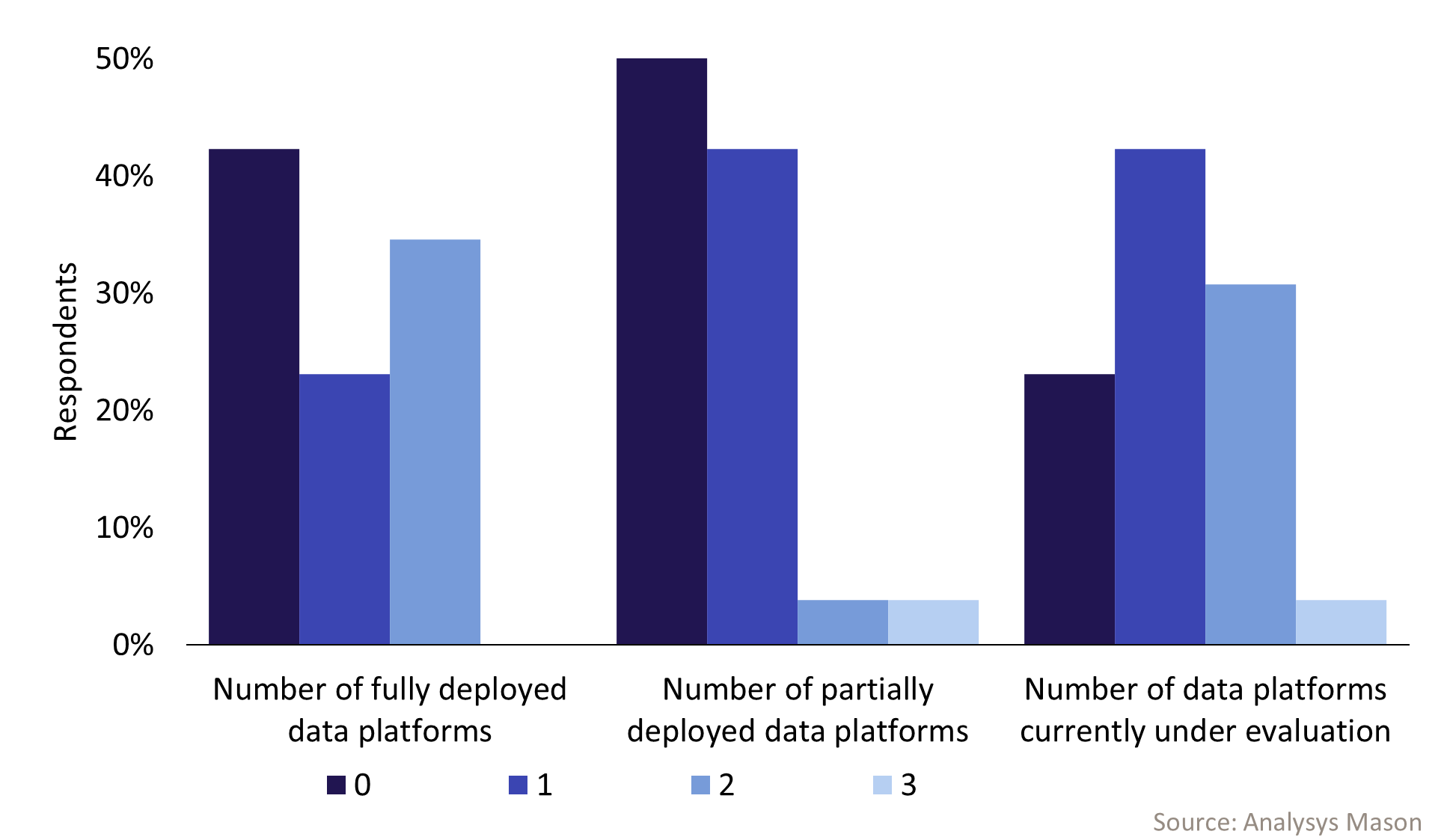
Figure 1: Number of telecoms operators from our survey that are actively deploying data platforms, worldwide, 20251
Operators have data platforms in place for AI, however the AI deployments are still immature
Based on our survey results, many telecoms operators are actively modernising their data environments (that is, moving their data from potentially hundreds of data sources, down to a few platforms). Most operators have deployed one or two data platforms, and many are evaluating additional platforms in order to complete this modernisation. Our survey results indicate that 58% of the operators we surveyed claim to have fully deployed either one or two data platforms. Of those that have not fully deployed a data platform, over 70% have either partially deployed data platforms or are actively evaluating data platforms that they would deploy. However, none of the respondents indicated that they have deployed or intend to deploy four or more data platforms.
These survey results point to a market in mid-transition rather than a fully mature market of data platform users. It also shows that operators will focus on limiting the number of data platforms they operate which will help simplify data-management-related operations and AI development activities.
AI is the main driver for most operator data platform investments. Over 40% of operators ranked accelerating AI led innovation as their top business driver for data platform investment, while scaling AI projects was the leading operational driver. Interest in generative AI (GenAI) and agentic AI is rising, however, operators report that machine learning- (ML) based analytics and business intelligence (BI) remain the most impactful operator data platform use cases. This demonstrates how valuable established ML- and BI-based deployments are to operators, but also the immaturity of current AI deployments and cautious adoption of new AI technologies.
Operators continue to face persistent challenges related to data fragmentation, budget constraints and access to high quality data when deploying data platforms, showcasing the immaturity of their AI deployments. Part of these issues is due to operators’ use of outdated data architectures. Existing data architectures focus on providing a central data environment to manage and access data. These centralised environments end up being operated in isolation because operators adopt a siloed approach to managing their operations. Consequently, existing architectures fail to support data-related projects such as AI development which require access to unified data. These problems limit the impact of existing platforms and reinforce the need for modern data architectures that support unified data management and strong governance.
Operators must reassess current data architectures and operating models with a view to adopting unified data management and governance practices which will secure ongoing AI investments.
Operators are starting to migrate to modern architectures to resolve data platform deployment challenges
To address architecture gaps, over half of the operators from our survey stated that they have started deploying modern data architectures, including data fabric, data mesh and data lakehouse designs. The objective is mainly to break down silos and support more flexible, scalable data operations. 52% of our respondents state that they are adopting one, or a combination of, more modern data architectures. These data architectures are flexible, scalable and can integrate with a broad range of systems and applications to support the needs of contemporary telecoms businesses.
Traditional data warehouse (DWH) architecture remains widely used among operators, as 48% of our respondents indicated that they are adopting this architecture. While DWH architecture is relevant to several data use cases including ML-based analytics and BI, most of the DWH systems do not support the management of unstructured data sets and create technical debt.2 Operators must have a plan to migrate to more modern architectures or systems, if they are to scale AI projects and reduce costs.
Future investment trends suggest that most operators will increase data platform spend, but with a measured approach
The survey suggests that operators will take a measured approach to spending on data platforms. Of the 26 operators surveyed, 21 expect to increase their investment in data platforms within the next 3 years. However, most of them (over 60%) plan to increase spend by a modest range of 1–10%. Over a 5-year horizon, 18 operators plan to continue increasing their investments and more than half anticipate investment rates to exceed 10%.
Operators will need to reassess what investments to make in the near term (0 to 3 years) and longer term (3 to 5 years). Their near-term investments should focus on eliminating existing data silos using modern and cloud-native data architectures and on establishing governance practices that will enable them to extract immediate value from existing investments and justify further spend. In the longer term, investments will then need to focus on capabilities that enable the fast scaling of data-driven projects including the establishment of the data products,3 marketplaces to access them and teams to manage them.
80% of operator respondents placed telecoms experience, as well as cost, in their top three selection criteria for data platform providers. Data platform providers must respond to this by setting up partnerships with companies that understand telecoms-specific data requirements and work with them to fill any existing gaps. Data platform providers should engage with telecoms mediation platform providers to meet telecoms operators’ needs. Their expertise in telecoms data curation ensures that high-quality data is available to drive various data-driven initiatives. Vendors should also offer comprehensive, cloud-native platforms that provide flexibility and scalability as the telecoms business landscape evolves.
By focusing on these qualities, operators and vendors can build an effective data foundation and make impactful progress in their AI journeys.
For more insights and information on telecoms operators’ adoption of data platforms in the AI era, see Analysys Mason’s AI and Data Platforms research programme. For further details on the key concepts highlighted in this article, please contact Adaora Okeleke.
1 Results from this figure are based on a recent Analysys Mason survey which included 26 Tier 1 and Tier 2 mobile-only or converged telecoms operators worldwide. This survey was conducted between August and November 2025.
2 Technical debt is the extra future work and cost an organisation “owes” itself due to its decision to select a faster, less optimal technical solution instead of a cleaner and more maintainable solution.
3 A data product is reusable, self-contained package that contains data and information related to the data (that is, metadata), semantics and templates that can support diverse business use cases. They are developed to be discoverable, interoperable and actionable so users can extract meaningful value from data generated across the organisation.
Article (PDF)
DownloadAuthor

Adaora Okeleke
Principal Analyst, expert in AI and data managementRelated items
Client project
Building a corporate strategy to achieve over 20% revenue growth, diversify the portfolio beyond core telecoms and harness AI-driven value creation
Client project
Developing a go-to-market strategy and a first-of-its-kind business case for an Asian telecoms operator’s entry into the GPUaaS market
Podcast
TMT predictions 2026: operators are at a crossroads