
Fixed–mobile convergence does not guarantee loyalty: operators must reward customers on these plans
23 February 2026 | Research and Insights
Article | PDF (4 pages) | Fixed–Mobile Convergence
"Customers that take fixed–mobile convergence bundles increase their spend much more quickly during their tenure; operators must ensure they hold on to these high‑spending customers."

The spend gap between customers that take fixed–mobile convergence (FMC) bundles and customers that buy fixed and mobile services separately widens significantly over time. FMC customers spend 27% more after their first year with an operator and 55% more after five years, according to Analysys Mason’s recent Consumer survey.
FMC customers spend more because they tend to select higher‑tier plans and additional services from the outset. The gap widens over time because these customers are more likely to stay on premium plans or upgrade to more expensive bundles during their tenure.
This premium is both an opportunity and a risk for operators. FMC customers may choose to unbundle and churn if they realise that equivalent fixed and mobile services are available at much lower prices. DIGI’s disruptive impact in Spain shows that FMC does not always secure long‑term loyalty.
It is critical for operators to retain higher-spending FMC customers, particularly at a time when consumer revenue growth is difficult to sustain. Fixed–mobile operators that pursue an FMC strategy must be proactive and reward long‑term loyalty with additional benefits throughout the customer lifecycle to minimise churn risk.
FMC is a long-term strategy
Figure 1 compares the average monthly spend on fixed and mobile services for two groups of respondents from Analysys Mason’s consumer survey:
- FMC customers’ spend, segmented by tenure with their fixed–mobile service provider
- The combined spend of customers that take only fixed or mobile services, based on their tenure with their respective service provider.
Figure 1: Spend on fixed and mobile services by respondent type and tenure, total panel, 3Q 20251
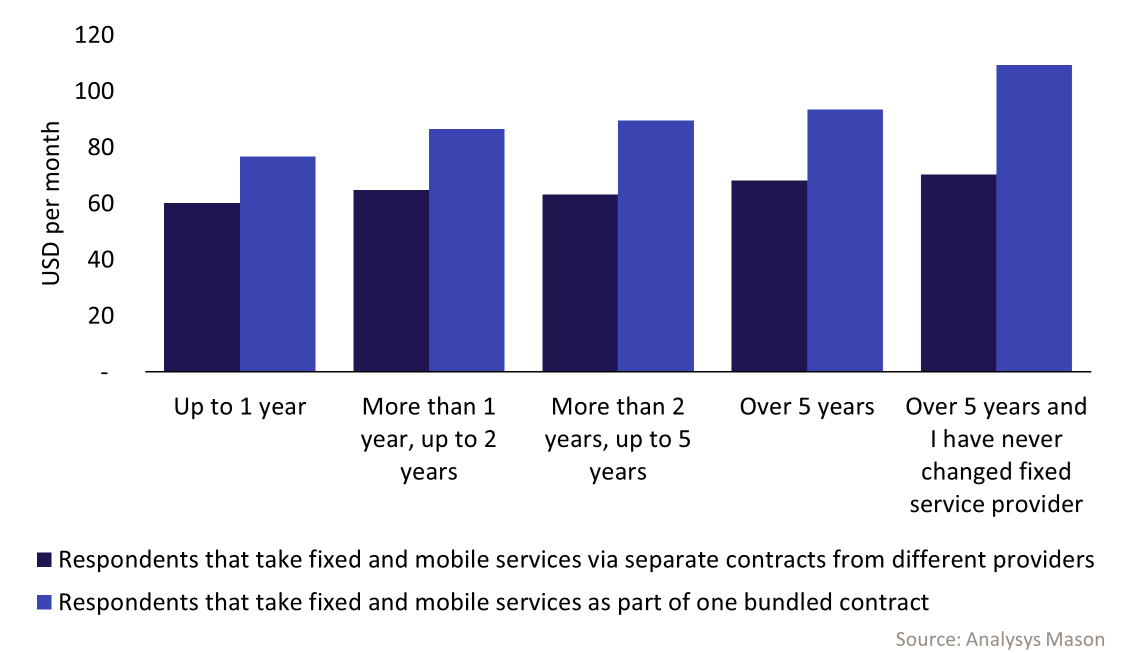
FMC respondents spend more on connectivity services and the difference increases with time. In the first year, they spend 27% more than respondents that use separate service providers for fixed and mobile services. This initial premium reflects their greater likelihood of taking higher‑tier plans (for example, plans with unlimited mobile data or high‑speed fixed broadband) and purchasing additional services (for an extra fee) such as video, music or cybersecurity.
The spend gap widens further over time, reaching 55% after five years, for the following reasons.
- Customers with long tenure naturally face price increases because many plans offered by operators include an introductory discount that expires over time.2
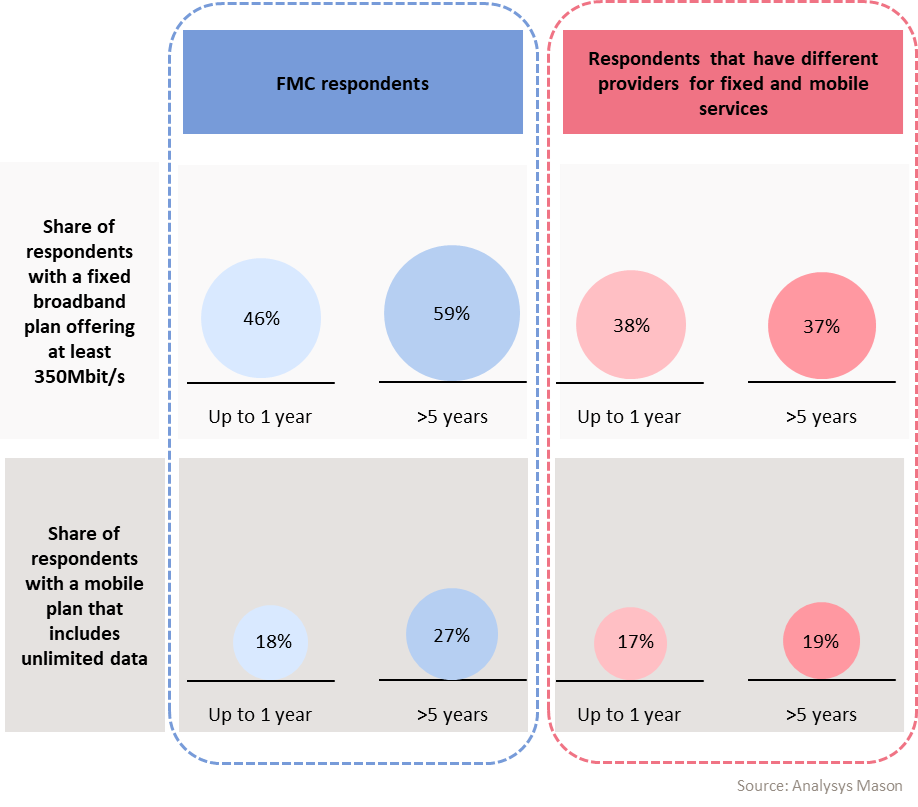
- FMC respondents are more likely to upgrade to top‑tier plans during their tenure with the operator (as Figure 2 displays) and/or to remain on plans that include additional services (particularly roaming, cybersecurity, music streaming and video), which are typically among the most expensive plans.
Figure 2: Share of respondents that take premium plans, by respondent type and tenure, total panel, 3Q 20253
An excessive price premium can put FMC customer retention at risk
Data from operators shows that FMC customers churn less than other customers.4 This partly reflects the inconvenience of switching both fixed and mobile services at the same time. The other factor is FMC customers’ higher satisfaction with their operator’s services.
However, FMC customers may realise that they are paying a price premium if (or when) they compare their current subscription with the offerings available from other service providers. In such cases, operators may unexpectedly face a situation where some FMC customers decide to churn.
FMC customers often miss out on discounts aimed at new customers (and do not check the market regularly) because of their disinclination to change fixed and mobile service providers. Yet they may choose to unbundle and switch provider for either fixed or mobile services (or both) if they consider the price premium too large. (Price remains, by far, the strongest predictor of churn intention in Analysys Mason’s survey data).
Operators must regularly reward FMC customers
FMC customers are extremely valuable for operators: they generate around 40% more revenue over a five‑year period than other customers.
Operators must therefore pay careful attention to these customers throughout their lifecycle. They should reward long tenure with increasing benefits to avoid falling into the trap described above. FMC customers should be encouraged to weigh their price premium against the benefits that they have accumulated over time to prevent them from switching to cheaper alternatives.
Operators have several levers at their disposable to enhance the value of FMC bundles and increase the complexity of switching.
- Additional services. Operators can broaden the number of services that customers take from them, including connectivity‑adjacent and beyond‑connectivity services. For example, KPN in the Netherlands rewards customers that add more services to their bundle. Customers can select one free service from a pre-defined list, once they reach a certain number of additional services. The more additional services they take, the broader the range of services (including premium options) that customers can choose from.
- Link benefits directly to tenure. For instance, AIS in Thailand launched a loyalty programme, AIS Serenade, where customers earn points for every amount spent once they pass a certain threshold. The threshold becomes lower for each year the customer has been with the operator. The points can be redeemed for services offered by third‑party partners.
- Build trust and engagement during the customer’s tenure. Operators can offer priority customer care to FMC customers and position themselves as trusted advisers for customers’ broader technology needs, expanding their role beyond that of a pure connectivity service provider.
Operators have multiple opportunities to add value to FMC bundles and reduce churn risk. They must be proactive throughout the customer lifecycle to ensure that FMC customers remain loyal, even when they become aware of the high price premium that they are paying.
Analysys Mason’s Fixed–Mobile Convergence programme monitors and analyses the strategies that operators worldwide use to promote FMC bundles. To discuss the findings in this article or explore how they apply to your company, please contact Stefano Porto Bonacci.
1 The results are drawn from a global panel of 19 000 respondents across 19 countries.
2 For more information, see Analysys Mason’s Fibre pricing benchmark 2Q 2025 and Analysys Mason’s Mobile pricing tracker (SIM-only plans) 1Q 2026.
3 The results are drawn from a global panel of 19 000 respondents across 19 countries.
4 For example, Verizon (USA) reports that “converged customers on fiber have a mobility churn rate that’s nearly 40% lower than our overall mobility base”. Verizon (October 2025), 3Q 2025 Earnings Conference Call Webcast.
Author

Stefano Porto Bonacci
Principal AnalystRelated items
Article
Singtel’s new 5G+ experience‑based plans show a new way to boost spend among premium customers
Article
Large operators should not be complacent about Digi's entry into the UK market
Article
MWC26: operators showed how they are reinventing connectivity to drive revenue growth