
The rationale for recent asset repurchases may resonate with operators
07 April 2026 | Research and Insights
Article | PDF | Operator Spending| Fibre Infrastructure
"Something between the asset-lite model and the vertically integrated model may yet emerge from the changeable fixed network landscape."

One of the knock-on effects of MTN’s proposed acquisition of IHS Towers is that the latter’s majority stake in the Brazilian fibre netco I-Systems will be sold back to its previous owner, TIM. This article considers recent transactions in telecoms infrastructure that reverse delayering (‘relayering’). Buying back towers is vanishingly rare, but there has been a steady trickle of deals in which fibre assets are repurchased, and there are common strategic rationales across both wireless and wireline infrastructure that suggest more could be on the way.
TIM is buying back its stake in an FTTP carve-out
I-Systems Soluções de Infraestrutura was created in 2021, when TIM Brasil carved out a neutral fibre netco and sold a 51% stake to IHS Towers, with TIM Brasil becoming the anchor tenant. TIM, the parent company of TIM Brasil, agreed to purchase this 51% stake in I-Systems in February 2026.
The repurchase of the IHS stake is expected to improve the cost structures of TIM Brasil. The operator said at the time of the deal: “By improving end‑to‑end connectivity quality, TIM aims to enhance customer experience, boost operational efficiency, and reinforce its position for upcoming FTTH opportunities, while maintaining a strong focus on profitability and cash generation”.1 This statement appears to imply that delayering had a negative impact on customer experience and on cost efficiency for the tenant. It also echoes some of the main reasons given by MTN for its acquisition of IHS: to “allow it to absorb the margins currently paid to IHS” and to “improve cost predictability”.2
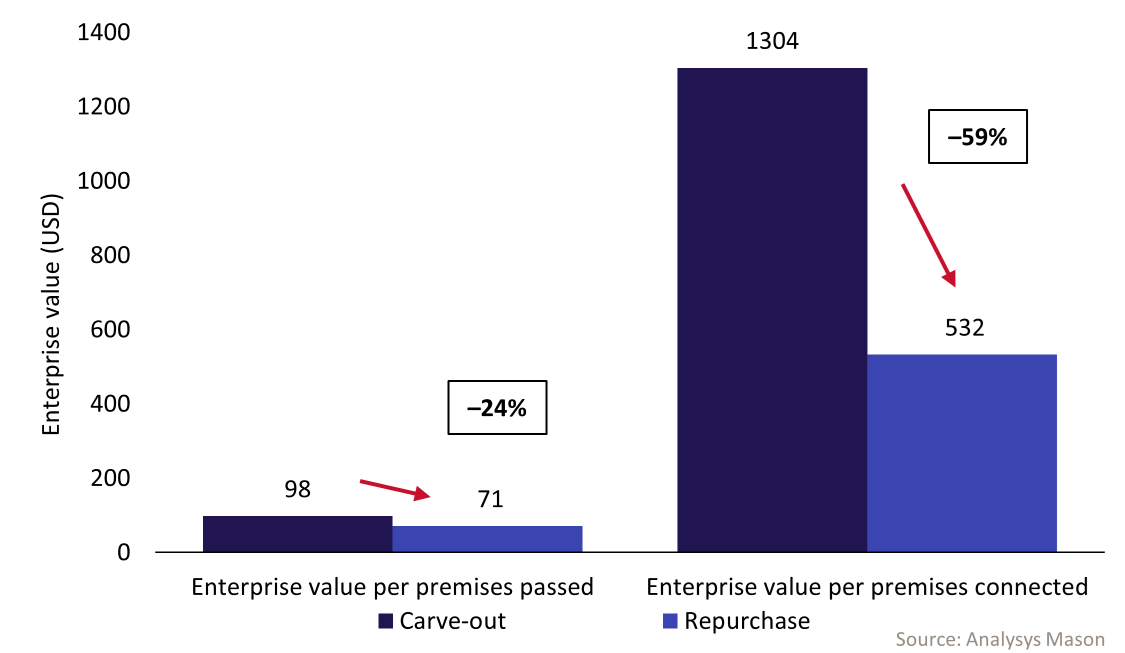
TIM paid much less per premises passed or per premises connected than it sold the stake for (Figure 1).3
Figure 1: Enterprise value multiples for I-Systems at the time of carve-out and of repurchase
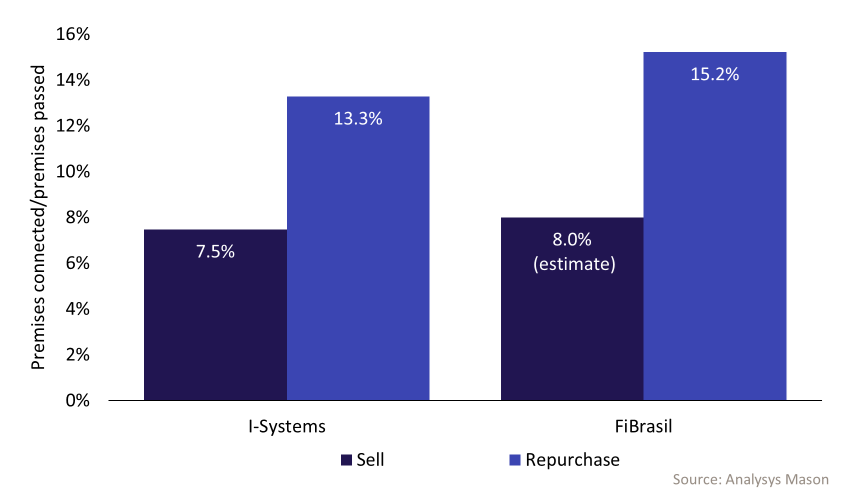
The weakness of the netco business contributed to this lower repurchase price. Brazilian FTTP is heavily overbuilt and I-Systems, as a challenger, perhaps proved too small (6.4 million FTTP premises passed) with a very low conversion rate at 13% (Figure 2). We estimate that over 90% of its FTTP active connections came through anchor tenant TIM Brasil, and despite some diversification into backhaul fibre and DAS, we estimate that well over 80% of its revenue came from this source too.
There is an additional irony in the repurchase because TIM has, in its Italian operations, recently been through one of the largest fixed-line delayerings so far seen.
The proposed I-Systems repurchase is neither a one-off nor a phenomenon unique to Brazil
There have been two previous relayering transactions in the Brazilian fixed market recently. One was the repurchase of CDPQ’s 50% stake in FiBrasil by Telefônica do Brasil (Vivo) in July 2025. This deal is very similar to the I-Systems one. FiBrasil infrastructure was in areas outside those where Telefônica do Brasil was the historical incumbent, and so FiBrasil was also a challenger. Moreover, conversion rates for FiBrasil were very low at 15% (Figure 2), not because there is a demand problem in Brazil – far from it – but because of oversupply.
Figure 2: Conversion rates of I-Systems and FiBrasil at the time of carve-out and of repurchase
The second relayering was the neutral netco V.tal’s acquisition of the retail FTTP subscriber assets of its anchor tenant Oi in November 2024. Unlike the other two transactions, the netco bought the servco, rather than vice versa. It represented a final stage in the winding-up of the bankrupt operator Oi, whose other assets had previously been sold.
Outside Brazil, Belgian operator Proximus bought back the EQT stake in its Flemish carve-out Fiberklaar in July 2024. This is part of a planned restructuring of the Flanders fixed infrastructure sector, whereby Proximus, through wholly owned Fiberklaar, and Wyre, a FTTP netco offshoot of Telenet, would divide low-density areas into two and sell to one another. It is possible that a similar arrangement between Orange Belgium and Proximus will appear in Wallonia. This plan still awaits regulatory approval. In addition, Uniti, a netco carved out from US regional broadband operator Windstream in 2015, remerged with Windstream in May 2024, with Uniti owning 62% of the shares.
The number of carve-outs of FTTP netcos has dwindled
In retrospect, it could be argued that fibre delayering was only ever a tactical response to funding needs rather than a fundamental shift to a more efficient and productive market structure. Carve-outs appear to have fallen out of favour from their heyday about five years ago; the last full one was the massive deal in Italy that created Fibercop. Analysys Mason’s FTTP valuation tracker has recorded no other since then, apart from the internal-only transaction in October 2025 that created the neutral netco Infranexia out of Telkom Indonesia.
Some major players have backed off delayering at the same time as Telefónica has decided to focus on integrated asset-ownership. In the UK, VMO2 pulled back from carving out a netco to fund the self-overbuilding of its HFC network with fibre. Perhaps it saw little wholesale potential in an already crowded market. In fact, the tenancy/revenue upside from most open-access carve-outs is small.4 Open access does not significantly increase the size or structure of the retail market. BT, as early as 2021, reportedly pulled plans to sell a stake in Openreach because it believed it could fund FTTP roll-out on its own.
More fixed network sharing may emerge
Repurchases are not cheap, but no retail play of any size aspires strategically to be a wholebuyer. Predictions that mobile and fixed operators would actively pursue an asset-light, opex-centric approach have not materialised and look in retrospect like wishful thinking by interested parties. Repurchasing means better cost control, not just because of the main leases in the master services agreement, but also because it can de-duplicate spending on, for example, OSS and BSS – duplications that arguably damage customer experience. Moreover, reintegrated operators will have better (that is, end-to-end) visibility of, and control over, network build strategy.
Many retail broadband players will prefer a form of co-investment or shared ownership to wholebuying from an open-access provider. There is no incentive for players in a bi- or multi-lateral network ownership arrangement with roughly equal market shares for each to maximise revenue from the others. They may seek to maximise the difference between the internal rates they apply to each other and the rates they apply to third parties if they choose to, or are obliged to, maintain an open-access wholesale play alongside their bi- or multi-lateral agreements. This could provoke regulatory scrutiny, but it would further encourage a shift from open access to co-ownership.
Analysys Mason brings extensive experience in FTTP, gained through research and customer projects. Our expertise can help stakeholders understand current trends in asset ownership and wholesale services. For further information, get in touch with Rupert Wood or Simon Sherrington.
1 IHS Towers (11 February 2026), IHS Towers Agrees to Sell its 51.0% Stake in I-Systems to TIM S.A..
2 MTN Group (17 February 2026), MTN Group announces proposed acquisition of IHS Towers.
3 For more information, see Analysys Mason’s FTTP valuation tracker.
4 For more information, see Analysys Mason’s Demystifying the delayering of telecoms operator businesses: outcomes and prospects.
Article (PDF)
DownloadAuthor

Rupert Wood
Research Director, expert in infrastructure, fixed networks and wholesaleRelated items
Tracker
Wholesale FTTx tariff tracker 2026
Article
Submarine cable launch figures increased in 2025, with another 144 cables planned for launch by 2030
Tracker
Middle East and Africa FTTP tracker 2H 2025