
Assessing market evolution scenarios for LEO broadband and D2D and understanding future implications for mobile operators and mobile network vendors

“Our role was to clarify a high-stakes decision marked by divided opinions on potential scenarios for the evolution of satellite technology, bringing together technology, economics and risk perspectives so that our client could make bold decisions with discipline.”
– Hugues-Antoine Lacour, Principal, Analysys Mason
The challenge
A leading global network equipment vendor wanted to understand the potential market evolution scenarios for low-Earth orbit (LEO) broadband and for direct-to-device (D2D), as well as the potential medium and long-term business implications for its terrestrial business
Rapid progress in LEO satellite broadband and D2D connectivity is changing how and where connectivity can be delivered. For terrestrial network equipment vendors, this creates a strategic dilemma: will satellite act as a substitute for or complement existing terrestrial networks?
Our client, a global network equipment vendor, had already conducted extensive analysis of both LEO broadband and D2D constellations, but required an independent, quantified and robust view of its potential scale, timing and geographical relevance through to 2035. It also needed to understand the opportunity and risk to its portfolio, separating credible growth pathways from unlikely scenarios, together with the hypotheses underpinning each.
The client engaged Analysys Mason to provide a detailed scenario-based assessment, grounded in our satellite and space consulting expertise and using Analysys Mason's proprietary research forecasts on LEO broadband and D2D as a starting point.
Our approach
We combined a structured scenario-based approach together with detailed market modelling to size the LEO broadband and D2D opportunity, identifying the clear business implications specific to our client
Drawing on Analysys Mason’s proprietary satellite and space research as a starting point, as well as in-depth expert interviews, we built a robust fact base on the potential scenarios of evolution for market structure, competitive landscape, technology and regulation to identify the main events, milestones, hurdles and strategic unlocks likely to shape LEO broadband and D2D adoption for the next 10 years (for example, constellation scale, spectrum, end-user devices, satcom technology, competition, standards).
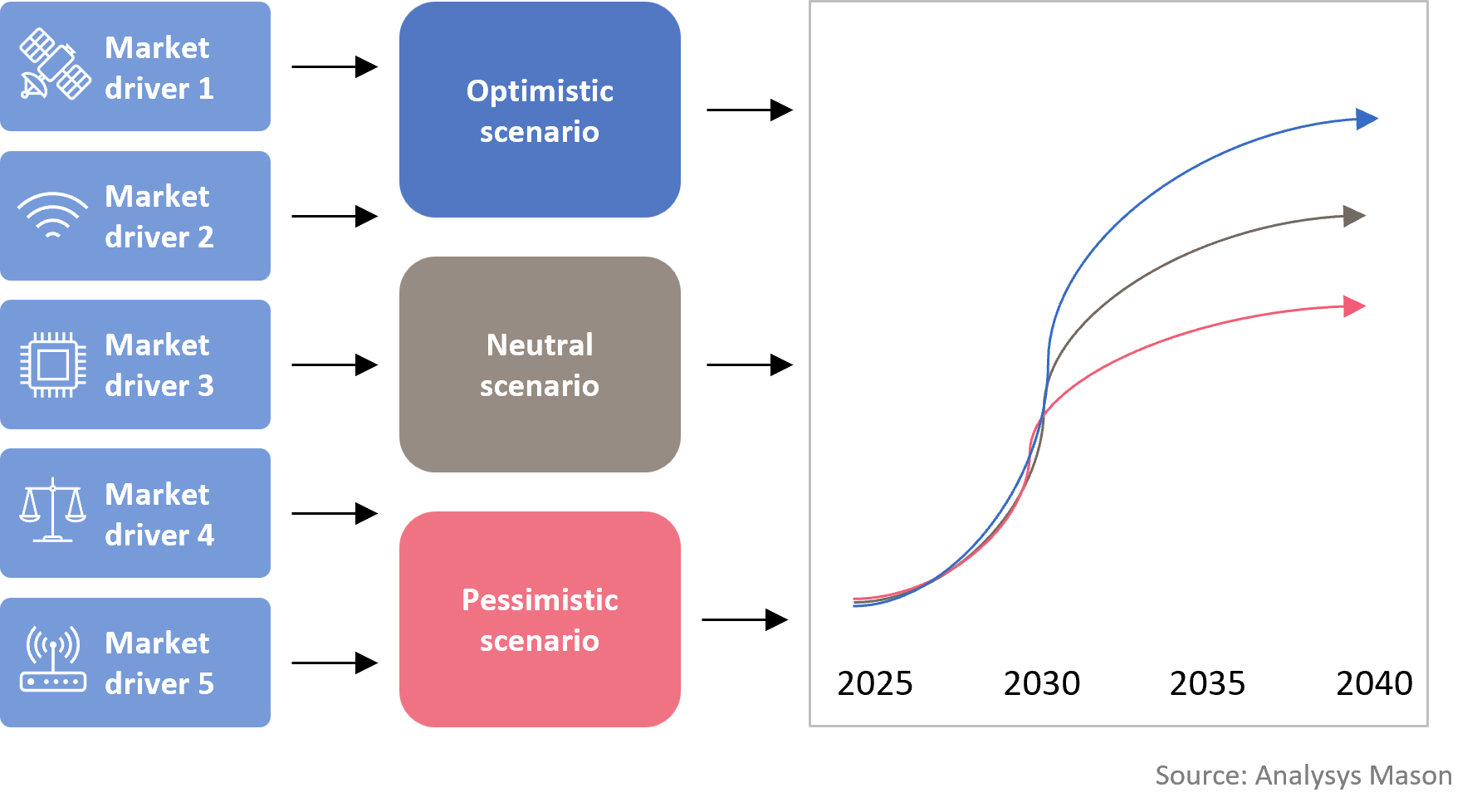
We then defined three market evolution scenarios (optimistic, neutral and pessimistic) to show how changes in key drivers could affect total capacity and unit costs, enabling LEO broadband and D2D to scale. This provided the clarity to move beyond a single standalone and static forecast to a dynamic view of possible futures depending on how changes in technology and regulation could affect evolution.
Figure 1: An illustrative view of a scenario-based framework, and its output
Next, we developed quantitative models to estimate current and projected LEO broadband and D2D service revenue across six countries, with regional breakdowns under each scenario. We worked iteratively with the client’s strategy and product teams to stress-test sensitivities, challenge assumptions and ensure that modelling results were transparent and decision ready.
Finally, we used these results to show the strategic implications to our client, including the potential value it could capture and the risks it could face in the very specific case of mobile operators using D2D instead of terrestrial sites in remote, low-traffic areas.
The impact
We provided a data-driven, scenario-tested view of LEO broadband and D2D adoption that strengthened our client’s strategic planning and investment decisions
Our work gave the client a clear, quantified view of where LEO broadband and D2D could drive growth, and where it could pose a manageable substitution risk to terrestrial networks. Client leadership gained a market-by-market view of the likely scale and timing of adoption in both broadband and D2D segments, with transparent assumptions that can be updated as the ecosystem evolves, as well as under new stretch assumptions for future evolution.
Our scenario-based framework helped the client strategy team test decisions against multiple plausible futures, improving confidence in long-term planning under regulatory, technology and competitive uncertainty, and a range of hypotheses on how underpinning drivers could develop.
Our analysis supported more disciplined investment planning by clarifying which opportunities warranted proactive moves now, and which were better monitored until key triggers (for example, performance, pricing or regulation) changed.
Contact

Antoine Grenier
Partner, expert in space and satellite, Consulting lead
Janette Stewart
Partner, expert in spectrum policy, pricing and valuation
Hugues-Antoine Lacour
PrincipalRelated items
Article
Telcos, it's time to dial up your space strategy
Podcast
Amazon makes its (long-expected) entry into satellite D2D with its USD11.6 billion acquisition of Globalstar
Client project
Assessing how LEO satellite could be a cost-effective broadband option to serve remote and rural areas of Europe for Amazon