
Where to find growth in a fast-changing B2B connectivity market
"The providers that will win in B2B connectivity are those that turn a complicated, shifting market into a small number of confident strategic choices."

Every business depends on connectivity. From the high-street coffee shop running card payments and stock orders, to the corporate headquarters supporting thousands of employees and a portfolio of cloud applications, data connectivity is as essential as electricity.
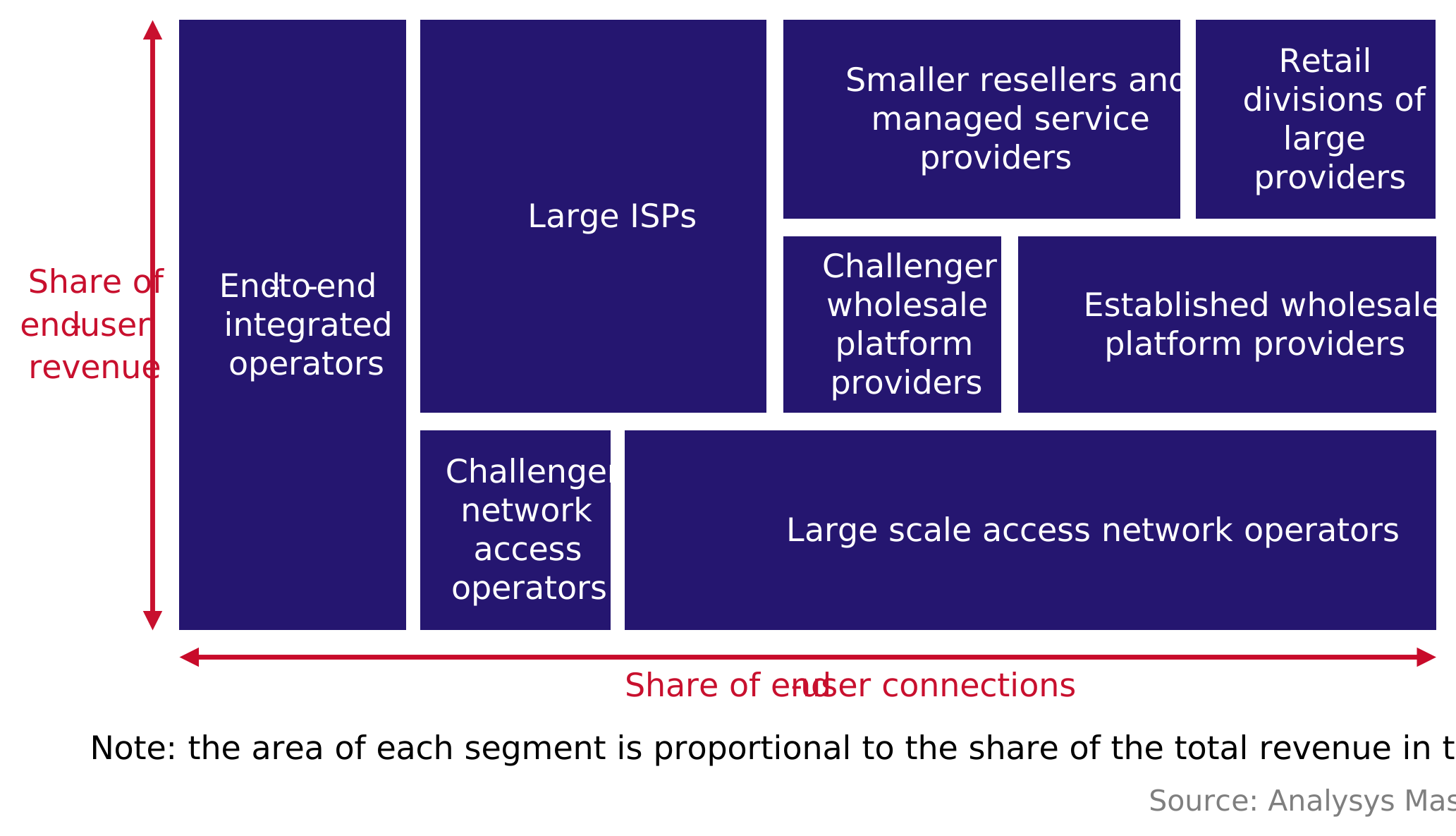
However, business-to-business (B2B) connectivity is very different to consumer broadband. The demand side is more exacting – businesses expect higher availability, faster fault response, symmetric bandwidth for upload-heavy workloads, and a clear line of accountability when something breaks. And they are often willing to pay for it. The supply side is also more intricate, with overlapping retail and wholesale relationships, multiple infrastructure and service layers (see Figure 1), and an expanding bundle of complementary ICT services. In addition, the market landscape for B2B connectivity providers is shifting fast. Continued growth requires a structured, evidence-based strategy rather than a business-as-usual approach that may have worked in the past.
Figure 1: Components of the total value of the business connectivity market
New infrastructure, new workloads, higher expectations
Three forces are reshaping the B2B connectivity market.
First, fibre-to-the-premises (FTTP) networks (including symmetric-capable XGS-PON) are filling the gap between traditional copper-based broadband and high-end dedicated Ethernet leased lines. Symmetric, business-grade services delivered over FTTP offer a compelling ‘bridging the gap’ proposition to businesses, due to their much higher bandwidth and reliability than copper-based broadband, at a much lower cost than Ethernet.
Second, businesses are becoming more dependent on data-driven processes. Cloud platforms, software as a service (SaaS), and a new wave of AI workloads have reshaped the importance of enterprise connectivity. As a result, the connection from office to the internet – or increasingly, from office to a specific data centre – has become a strategic asset rather than a back-office utility. Bandwidth requirements are continuing to rise, but a more telling shift is the rising expectations for resilience and consistent performance.
Third, security and the control of traffic flows now rank alongside raw bandwidth as purchase drivers. In our recent primary research with enterprise buyers, security and reliability consistently outranked headline speed and price when choosing a dedicated connection. Multi-site businesses with hybrid workforces and complex IT estates are leading this shift, often using networks based on software-defined wide-area network (SD-WAN) or secure-access-service-edge (SASE) technology.
Rigorous analysis can turn a complex, multi-layered market into clear strategic choices
A market this layered cannot be navigated with simplistic analysis. Across our recent client work, we have applied a consistent set of techniques, tailored to answering clearly defined strategic questions.
Sizing the market with confidence. We piece together data on customer volumes, revenue and market shares, and compare these to national statistics on the number, size and sector mix of businesses. We combine these top-down numbers with bottom-up assumptions to create a rich picture of the different market sub-segments. The output is a defensible baseline that boards and investors will understand and accept.
Forecasting how the market will evolve. The headline volumes tell only part of the story. The harder question is how connections migrate between technologies and product tiers as new infrastructure arrives, competition intensifies and customer needs change. We build forecasts that separate underlying business demands from technology substitution, so clients can see where revenue is genuinely expanding and where it is simply moving between products.
Defining the right product portfolio. The business connectivity market is very broad in scope, from near-consumer business broadband through to high-end, fully managed Ethernet. Depending on the target market, and the need to be flexible to changing client needs, a graduated ladder of products brings significant competitive advantage. Each step requires deliberate choices on bandwidth, symmetry, contention, service levels and pricing. We work through these trade-offs against the addressable demand at each tier, so product development efforts target where the willingness to pay actually sits.
Pursuing specific connectivity niches. Some of the most attractive opportunities sit in well-defined niches, such as enterprise-to-data-centre links, dedicated routes for financial services or private connectivity for multi-site retail and healthcare estates. Publicly available data rarely has the answers to help address these strategically important customer groups. We use primary research with real business end users, combined with infrastructure footprint analysis, to size the prize and identify which niches a given provider is best placed to win.
In each case, our role is to turn a fragmented picture into a clear strategic plan to help our clients drive growth in revenue and margins.
Find out more
Analysys Mason has supported infrastructure investors, wholesale operators, retail service providers and public-sector buyers across Europe and beyond on the issues raised in this article. If you would like to discuss your own B2B connectivity strategy, please contact Andrew Daly.
Article (PDF)
DownloadAuthor

Andrew Daly
Principal, expert in strategy, regulation and policyRelated items
Article
Operators must look beyond speed and price to differentiate their business broadband services
Article
Monetisation of the AI value chain must reflect both the benefits of AI and the underlying cost structures
Article
Edge AI: why telecoms operators should look again at edge computing