
From 10MHz to scale: spectrum strategy for satellite D2D
27 May 2026 | Regulation and Policy, Strategy, Transaction Support
Janette Stewart | Antoine Grenier | Chris Nickerson
Article
"D2D may start as a coverage feature, but it is quickly becoming a strategic spectrum and competitive positioning decision for MNOs."

Satellite direct-to-device (D2D) services are in early real-world use. There are live offerings in selected markets on selected devices, and commercialisation is advancing rapidly. For satellite operators and mobile network operators (MNOs), the immediate strategic questions are how much spectrum is needed to deliver an attractive, viable service to customers, and how to scale that service effectively. This article examines D2D spectrum requirements from three perspectives that matter to telecoms operators:
- Designing for scalable market demand
- Balancing the complex challenges of combining new satellite and existing terrestrial spectrum
- Adapting to global and regional regulatory roadmaps, including the push for greater spectrum harmonisation and outcomes from the World Radio Communications conference in 2027 (WRC-27).
Capacity demand in 4G/5G networks means MNOs can initially only clear a minimum amount of spectrum to establish D2D
From initially limited services and device-specific applications, the D2D market is rapidly evolving towards broader commercial launches. Nearly 70 MNOs now offer ‘satellite’ to their customers as an add-on service. MNOs position D2D services as a solution that enables mobile users to achieve basic connectivity for messaging or voice using their existing handset, in areas without terrestrial coverage but where satellite coverage could play a role to reduce coverage gaps. MNOs are careful to point out that current D2D satellite coverage is currently intermittent, not always available and should not be relied on due to limitations in existing satellite constellations. However, constellation capacities and capabilities are expected to evolve, enabling increased consistency in outdoor coverage with higher capacity. The amount of capacity offered is closely linked to the spectrum bandwidth that is available, as well as the design of the satellite constellation and the mobile device.
Early D2D use cases, such as emergency and basic two-way messaging, intermittent connectivity and limited IoT-style traffic, have a relatively modest spectrum requirement of around 2×5MHz. This is a manageable amount for MNOs that operate within a much broader terrestrial spectrum portfolio. In such spectrum-rich markets, operators may hold 100MHz or more, plus a further 100–200MHz in mid-bands above 3GHz. However, terrestrial spectrum is intensively used in highly populated areas to support the significant volumes of mobile broadband traffic carried by 4G and 5G networks in those locations. In less developed markets, operators may have holdings of 60MHz or less below 3GHz and no holdings above 3GHz. This more limited spectrum capacity may make it challenging for MNOs to release even small amounts of bandwidth for D2D.
Providing D2D services within a 10MHz bandwidth constrains the resulting service that can be offered to users. However, despite the limited bandwidth, D2D services may still appeal to MNOs and their customers. Claiming to have the ‘best’ coverage in a market may help operators retain customers and attract new ones.
In some regions, MNOs may be required to offer ubiquitous geographical coverage of basic services (for example voice and/or messaging) in future. This was recently proposed in Australia under its Universal Outdoor Mobile Obligation, for example. The costs and practicalities of providing 100% geographical coverage via terrestrial networks would preclude this being achievable, and hence D2D could play a key role to reduce coverage gaps under such assumptions.
Beyond the initial commercial upside, the more strategic value of D2D is customer retention. Coverage gaps can drive customer dissatisfaction and might ultimately cause customers to churn – especially high-value customer segments that travel or work outdoors, or those who live at the edge of the terrestrial footprint. D2D offers a credible way to reduce customer dissatisfaction. Even if services are limited to low-rate messaging, demonstrating broad coverage reach using existing user devices will strengthen an MNO’s market position.
Setting aside an initially low amount of spectrum presents some risks for MNOs, however. As demand increases, capacity that is already limited will become increasingly congested. Given that MNOs typically offer D2D services as a priced add-on to data packages, MNOs will want to ensure the D2D service is scalable to meet increased demand and customer expectations.
As D2D services move beyond initial concepts, additional spectrum will be needed to scale the capacity provided. There are two options at this stage: either provision additional terrestrial spectrum in satellites, or use spectrum already allocated to mobile satellite services.
A recent article by Analysys Mason discusses these two approaches to spectrum for D2D, namely using terrestrial spectrum and using mobile satellite spectrum (MSS), in more detail. As described in the next section, the choice of spectrum for D2D presents complex trade-offs.
Scaling initial D2D services leads to strategic choices on spectrum
For MNOs who are choosing to clear a block of terrestrial spectrum for D2D use, the frequency block(s) to be used will be determined by a combination of factors. These include the MNO’s network deployment (how many sites the operator has and what spectrum configurations are used at each site), the devices that its customers use, and requirements for the integration with the D2D satellite constellation. Regional harmonisation of similar spectrum band use and rules will also be key. At a general level, there have been two initial options: use spectrum in bands below 1GHz (as AST SpaceMobile and Lynk have done) or use spectrum in the 1–3GHz range (as Starlink has done).
Regulatory requirements for efficient use of spectrum must also be considered. The relevant national regulatory authority (NRA) needs to authorise use of terrestrial spectrum in satellites, to ensure co-ordination among spectrum users and to avoid harmful interference. To date, NRAs that have published authorisation rules for terrestrial spectrum in space have taken slightly different approaches. Co-ordination among NRAs is accelerating and various regional studies are underway. This has been prompted by international discussions on D2D spectrum use that will take place at the forthcoming WRC-27, and by spectrum in L-band or S-band becoming available (for example, Europe’s future 2GHz MSS licensing). Broader regulatory requirements relating to D2D are still forming.
As demand for D2D services grows, service requirements are likely to extend beyond the reuse of terrestrial spectrum, and increase the relevance of MSS spectrum for D2D. In parallel, inclusion of MSS L-band and S-band spectrum in 3GPP specifications is accelerating low-earth orbit (LEO) investment and consolidation. Recent activity spans consolidation of spectrum assets (for example Omnispace/Lynk and Viasat/Space42) and acquisitions motivated by access to attractive spectrum holdings (such as Amazon/Globalstar). Terrestrial and MSS spectrum have different benefits and constraints; a mixture of both may be needed to enable scalable D2D.
Figure 1: A mix of terrestrial spectrum and MSS is the key enabler of scalable D2D
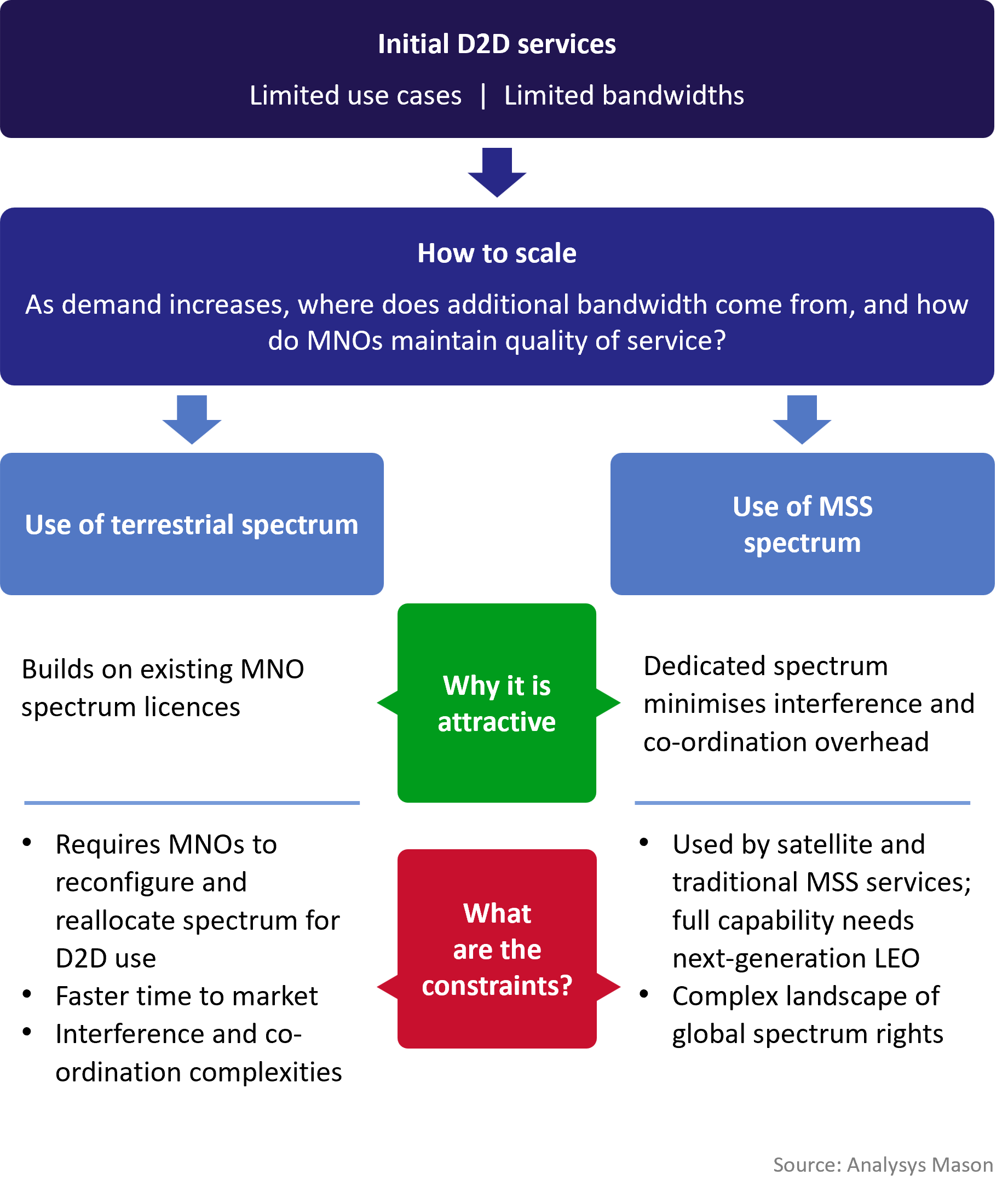
Determining the right mix of spectrum for D2D, including amounts, type and configuration, will be central to the long-term commercial success of D2D.
Regional spectrum co-ordination will be important not just for regulation, but also to maximise customer reach and to improve the services that satellites can offer. Supporting fragmented spectrum blocks creates compromises in LEO constellation design. MSS allocations that are well co-ordinated and adjacent to terrestrial spectrum allocations (specifically S-band) are therefore increasingly attractive for D2D. WRC-27 will discuss the use of terrestrial spectrum in satellites and will also consider whether existing MSS allocations are sufficient or whether additional allocations are needed.
Analysys Mason helps operators, investors and spectrum stakeholders to transform D2D from a technical possibility into a viable commercial strategy. We combine deep expertise in spectrum policy, satellite markets and telecoms strategy to assess spectrum options, partnership models, regulatory positioning and the long-term business case for D2D. To discuss your D2D spectrum strategy, market positioning or policy roadmap, get in touch with our experts.
Authors

Janette Stewart
Partner, expert in spectrum policy, pricing and valuation
Antoine Grenier
Partner, space and satellite, Consulting lead
Chris Nickerson
ManagerRelated items
Article
Telcos, it's time to dial up your space strategy
Client project
Assessing market evolution scenarios for LEO broadband and D2D and understanding future implications for mobile operators and mobile network vendors
Article
Spectrum choices dictate the launch and evolution of D2D services