
German data centre opportunity moves beyond Frankfurt
16 September 2026
Press release
MUNICH, GERMANY
- German enterprise demand for co-location data centres set to grow by 8–9% p.a. to 2030
- Six regional markets are gaining momentum beyond Frankfurt
- Mittelstand, data sovereignty and resilience are driving local demand
- Winners and losers will emerge as cities compete for investment
Germany’s data centre market is decentralising in line with the country’s economic structure. Unlike markets dominated by one capital city, Germany has several strong regional business centres, and enterprise co-location demand is spreading beyond Frankfurt, according to Analysys Mason.
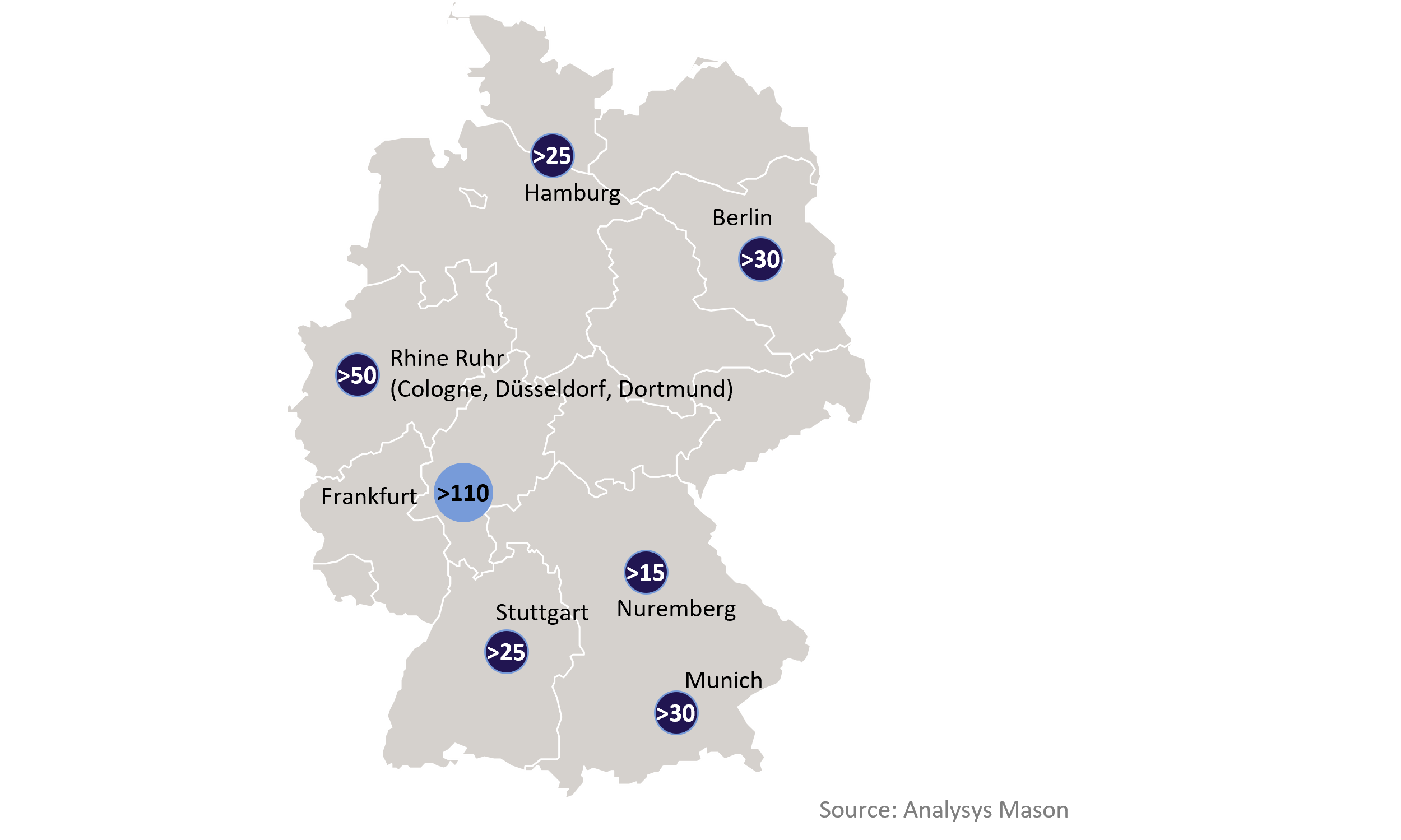
Figure 1: Number of co-location data centres in Germany, by region (live and facilities under construction)
Investor interest in hyperscale-focused data centre platforms has grown strongly in recent years, driven by rising investment in AI and cloud infrastructure. Major technology companies such as Microsoft, Google, AWS and Meta increasingly rely on third-party providers to support this expansion. This creates opportunities for enterprise co-location providers, particularly in regional German markets where companies want infrastructure closer to their operations.
Enterprise co-location demand is expected to grow by around 8–9% p.a. between 2025 and 2030, driven by the ongoing digital transformation of the German Mittelstand, alongside rising demand for regional private cloud and co-location capacity, AI, hybrid IT and Germany’s strong focus on data sovereignty. Given the often regional footprint of German small and medium-sized enterprises (SMEs), co-location requirements are inherently local, reflecting the need for proximity to customers. As a result, demand is most effectively served at the metropolitan level.
Companies and public-sector organisations increasingly focus on where data is stored and processed, making local and regional data centres more attractive.
“Germany’s data centre opportunity is moving beyond Frankfurt,” said Mirko René Gramatke, Partner at Analysys Mason. “There is increasing demand for regional digital infrastructure.”
Local industry strength will shape where growth happens. Regional demand drivers vary significantly: Berlin benefits from public-sector and digital-economy activity, Munich and Stuttgart from automotive and industrial strength, and Cologne/Düsseldorf, Hamburg and Nuremberg from sectors including telecoms, logistics, media, software and industrials.
Not every regional market will benefit equally. Industry mix, existing capacity, development pipelines, power availability, connectivity, available sites and realistic absorption rates will determine which cities attract investment, experience shortages or face excess capacity.
Resilience and cyber security are also becoming stronger demand drivers, as companies seek geographically separate sites to keep operating during outages, cyber incidents or other disruptions.
For investors, this creates a clear city-level selection challenge. A wave of investment could reshape Germany’s regional digital infrastructure, but value creation will depend on choosing the right cities and building scalable platforms where demand, access to power and connectivity align.
“Investors should not only rely on growing data centre demand in a competitive Frankfurt market,” added Gramatke. “There is also a growing demand for local DC capacity, and the key question is whether the currently regional supply in the metropolitan areas in Germany can keep up with digitalisation.”
Media contact:
Karin Duke-Roedler, Marketing Director
Karin.Duke-Roedler@analysysmason.com
Phone: +44 7966 996608
About Analysys Mason
Analysys Mason is a global specialist consultancy focused on technology-intensive industries, including telecoms, digital infrastructure, software, IT services, space, defence, manufacturing and logistics. We support businesses, investors and governments with strategy, transaction support, regulation, transformation and research.