
Regulators should define clear spectrum rules to foster innovation in satellite D2D
02 June 2026 | Research
Article | PDF | Satellite D2D| Space Spectrum | Space | Governments & Regulators
"Countries seeking to lead innovation in satellite D2D should develop forward-looking regulatory frameworks that facilitate the use of terrestrial spectrum from space and create legal certainty for investment."

Satellite direct-to-device (D2D) services are moving rapidly from trials to commercial reality. Yet spectrum access and the regulations governing it have become bottlenecks for scaling D2D services, often deterring investment. Mobile satellite spectrum (MSS) is scarce and controlled by a few players, and the pool of compatible devices remains small. The use of IMT1 spectrum from space has been crucial for accelerating D2D adoption because these networks allow some backward compatibility with existing phones. However, the use of terrestrial spectrum from space requires the modification of traditional spectrum legal frameworks and, in many countries, delays in this process are postponing the launch of D2D services.
Analysys Mason’s report Terrestrial spectrum from space: regulator case studies and analysis explores the regulatory models that already enable D2D. Forward‑looking regulatory approaches that provide certainty for investment are essential to unlock the next phase of D2D growth.
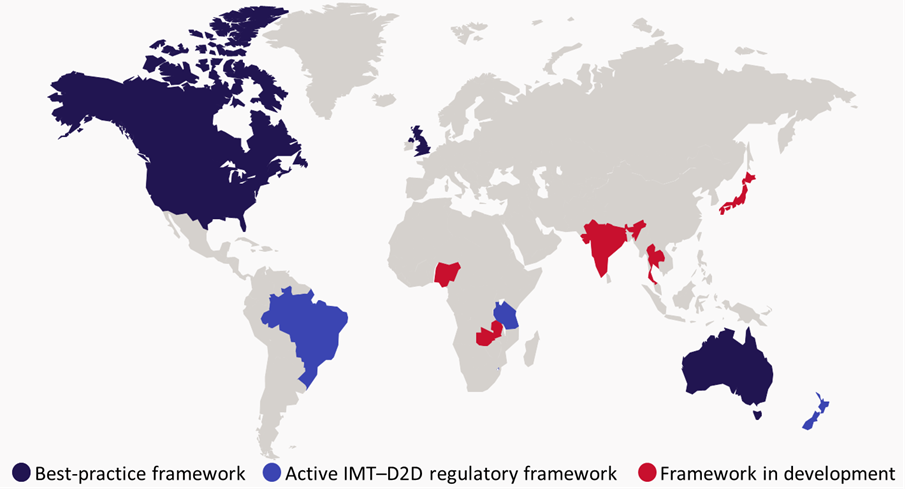
Figure 1: Countries with regulatory frameworks that define the use of IMT spectrum from space
Source: Analysys Mason
Only five countries currently have active regulatory frameworks that define the commercial use of terrestrial spectrum from space
Australia, Canada, New Zealand, the UK and the USA are the five jurisdictions worldwide with active frameworks enabling D2D–IMT services.2 Many other administrations are either deterring the launch of services or allowing services to proceed through exemptions. Regulators may approve a licence variation, a temporary authorisation or a tightly scoped trial while broader changes in frequency rules are debated. This approach may unlock early testing and even some commercial services, but it creates uncertainty around investment, the scaling of services and interference-mitigation obligations.
Clearly defined regulatory frameworks have enabled a first‑mover advantage in the launch of commercial D2D services. In the USA, the FCC’s Supplemental Coverage from Space (SCS) framework created a predictable path for partnerships and spectrum sharing, which facilitated the deployment of the pioneering T-Satellite service in mid-2025. Similarly, in the UK, Ofcom’s authorisation framework enabling D2D services rapidly translated into market momentum with the launch of Virgin Media O2’s (VMO2’s) satellite service in partnership with Starlink in February 2026. This positioned the UK as a leading D2D mover in Europe. Full regulatory frameworks, such as those seen in the USA and the UK, reduce adoption friction by defining licensing processes, interference-mitigation measures and technical rules. They shorten time to market for MNO–satellite deals and create certainty for investment and innovation – advantages that ad hoc waivers cannot deliver.
A common regulatory baseline is emerging among the regulators that allow the use of IMT spectrum from space
Active regulatory frameworks align in that IMT spectrum used from space for D2D is only allowed on a secondary, ‘non‑interference and non‑protection’ basis. This principle protects incumbent terrestrial mobile users while giving regulators a pragmatic path to enable innovation ahead of WRC‑27.3 The other point of convergence among regulators is the operating model: access to IMT spectrum for D2D satellite operators requires a partnership with the MNO holding the licensee for that portion of the spectrum. This requirement is central to spectrum co-ordination and compliance. Regulators increasingly expect that interference risks are anticipated and managed through co-ordination arrangements, with a clear ‘stop or fix immediately’ position if harmful interference occurs. This baseline is becoming the de facto template even if countries differ on how formally they apply it: via full frameworks, interim rules or the approval of exceptions.
Jurisdictions diverge in how prescriptive the regulations are. Licensing frameworks range from light‑touch approaches that leverage existing MNO licences, to more structured regimes requiring explicit authorisations. The bands that D2D services are allowed to use also vary; some regulators specify the bands approved for D2D, while others show more flexibility. In addition, interference mitigation can be very different depending on the jurisdiction, with various levels of control over power flux density limits, out‑of‑band emissions requirements and operational constraints such as geographical limits, border protections or minimum elevation angles. Compliance assurance and responsibility also varies depending on the jurisdiction. However, in most cases, regulators place the responsibility for meeting service conditions on the MNO, given that it is the domestic licensed operator and the entity that they can directly take action against. The satellite operator is expected to comply via the partnership and the technical design. The shared premise is clear: permit D2D, but make protection of incumbents explicit and enforceable and leave the door open for future regulatory changes as the technology evolves and WRC-27 approaches.
A globally harmonised approach is the most desirable outcome, but that can only occur after WRC-27
WRC‑27 is likely to be pivotal to D2D. After the conference, administrations are expected to address how satellites can directly serve standard IMT user equipment and what technical and regulatory conditions must apply to protect incumbent mobile networks. A clear outcome at WRC‑27 could enable a globally harmonised framework to replace today’s patchwork of national waivers and licence variations. This would make globally scalable deployments more predictable, and thus de‑risk national approvals and incentivise investment in the development of D2D capabilities. Conversely, a weak or fragmented outcome would prolong regulatory uncertainty, resulting in higher compliance costs, slower service rollouts and more expensive engineering and certification.
Analysys Mason offers deep expertise on the intersection of satellite D2D and spectrum. Our Satellite D2D and Space Spectrum programmes include specialist research on this topic. Our space experts have engaged in consulting projects for clients across the D2D value chain, shaping their business plans, helping them navigate the regulatory frameworks and supporting due diligence.
1 IMT stands for International Mobile Telephony. It is used to indicate spectrum that is reserved for mobile network operators (MNOs). It is also referred to as terrestrial spectrum in this article.
2 As of May 2026.
3 WRC is the International Telecommunication Union’s (ITU’s) World Radiocommunication Conference. It provides a forum for countries to revise the ITU Radio Regulations, including spectrum allocations. It is held every 3–4 years; WRC‑27 is the next conference.
Article (PDF)
DownloadAuthor

Lluc Palerm
Research Director, expert in satellite communicationsRelated items
Article
European sovereignty-led spending will force vendors to be more selective about opportunities
Article
Moon base plans will push back the lunar market opportunity
Podcast
D2D: T-Mobile's path to seamless connectivity