
Delivering a resilient, innovation-ready emergency call-answering service for Ireland

“Analysys Mason helped deliver a resilient emergency call-answering service that supports today’s needs and can adapt to future innovation.”
– Stephen Roe, Senior Manager, Analysys Mason
The challenge
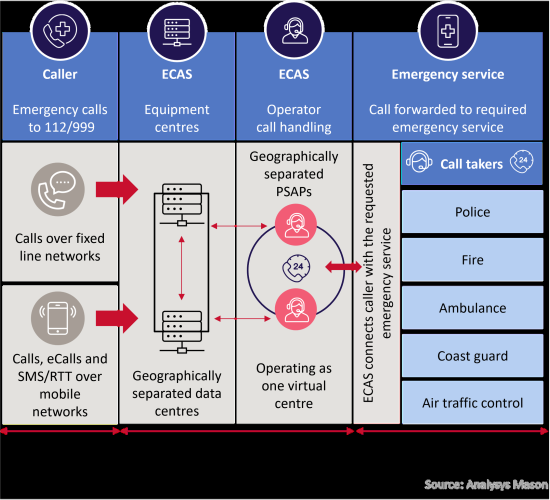
In Ireland, the Emergency Call Answering Service (ECAS) receives calls to 112 and 999 as well as emergency communications made via eCall, SMS or real time text (RTT). ECAS is a critical national service that connects people with the appropriate emergency response organisation and routes them to police, fire, ambulance, coast guard and/or, where relevant, air traffic control.
The Irish government is responsible for ensuring that Ireland has an effective, reliable ECAS nationwide.
Our client, the relevant government department,1 needed to appoint a provider to operate and manage a sophisticated, resilient call-answering service for Ireland’s emergency response infrastructure. The service had to continue operating in the event of a disaster and be ready to adapt to new technologies and changing public needs. These included next-generation 112 services (NG112), satellite communications, text-based emergency messages, eCall in-vehicle accident alerts and improved accessibility for vulnerable users and people with disabilities.
Figure 1: Emergency call handling process from caller to appropriate emergency response organisation
The department needed independent technical, commercial, financial and procurement advice to define requirements, select the right provider and assure delivery through to go-live.
Our approach
We worked with government, emergency-services, regulatory and industry stakeholders to define the service requirements and develop the commercial and technical tender materials. We managed the Competitive Dialogue2 process, evaluated supplier submissions and supported the department in selecting the preferred bidder.
Following contract award, we monitored delivery against the implementation plan, certified key milestones and reviewed acceptance testing. We also carried out site visits and produced the commissioning report, giving the department assurance ahead of service launch.
The impact
The project helped Ireland maintain a reliable, resilient emergency call-answering service for the public. The department had a clear contractual and operational framework for managing a critical national service, with government, regulatory and emergency-service requirements built into the new concession. The service launched with tested processes, agreed standards and the flexibility to support future innovation in emergency communications.
1 We worked with the Department of Communications, Climate Action and Environment. Responsibility for the Emergency Call Answering Service has since moved to the Department of Culture, Communications and Sport.
2 EU-regulated procurement procedure where buyers and bidders jointly develop complex solutions.
Emergency calls in Ireland are free to callers on all networks. ECAS is funded through the Call Handling Fee, paid for by telephone network operators and service providers when their customers call the service. Analysys Mason subsequently supported the regulator in reviewing this funding mechanism.
Contact

Patrick Kidney
PartnerRelated items
Newsletter
Consumer internet and digital media monthly | From funding boom to sustainable growth – what comes next for India’s agritech sector
Client project
Providing a postal regulator with a robust evidence base for policy reform
Article
AI bill shock: could rising costs drive enterprises to run their own AI infrastructure?