
Informing AirTrunk and Blackstone’s GCC data centre market entry through market understanding and investment intelligence
11 November 2026 | Strategy
Rohan Dhamija | Johann Adjovi | Sameer Gupta | Arun Pai
Client project | AI | Data centres | Digital Infrastructure

“The real value was separating market excitement from investable opportunity. We helped AirTrunk and Blackstone identify where demand, infrastructure readiness and economics aligned to support long-term growth.”
– Rohan Dhamija, Managing Partner, Head of Asia–Pacific & Middle East, Analysys Mason
The challenge
AirTrunk and Blackstone needed to understand hyperscale growth potential in the GCC and across individual markets
Government-led digitalisation, cloud adoption and AI workloads are accelerating demand for data centre capacity across the Gulf. In this context, AirTrunk and Blackstone were evaluating opportunities for greenfield hyperscale data centre development in Saudi Arabia and other Gulf Cooperation Council (GCC) markets. However, strong demand does not necessarily translate into suitable land, available power, connectivity or competitive economics. Market maturity and supply pipeline also differed considerably between countries and cities. The clients needed to establish where future demand could translate into deliverable opportunities and which risks warranted further investigation. They engaged Analysys Mason to provide independent, comparable market intelligence to inform their regional entry decisions.
Our approach
We combined global data centre insights with detailed local experience and evidence to assess growth and deliverability
We drew on our unique market insights, strong relationships and ongoing discussions and project work with leading data centre players in the Middle East to assess individual markets in detail, combining demand forecasts with practical considerations for greenfield development.
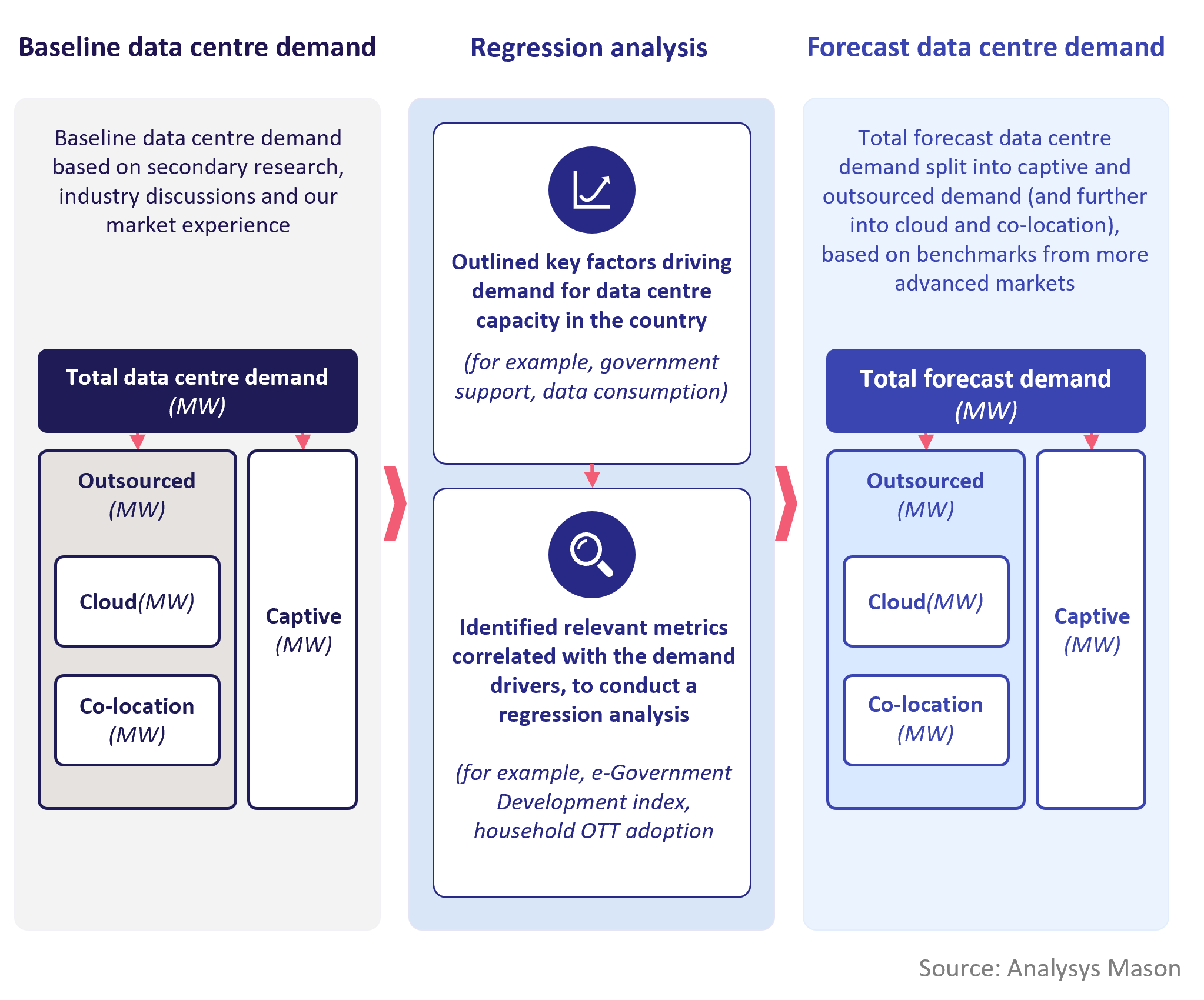
First, we assessed current and future demand for data centre capacity, separating conventional co-location requirements from hyperscale, AI and GPU-as-a-service (GPUaaS) opportunities. We examined the implications of cloud adoption, AI infrastructure investment and other growth drivers, and used wider industry insight to establish a robust demand outlook.
Next, we built a consistent picture of existing and announced data centre supply, mapping major providers, facilities and expansion pipelines to compare competitive intensity and future capacity availability across markets at different stages of development.
We then linked market attractiveness to development economics. At a city level, we reviewed enterprise and hyperscaler co-location pricing alongside electricity tariffs, land prices and relevant incentives, highlighting factors that could affect the viability of a new hyperscale facility.
Finally, we mapped leading data centre clusters and examined site-enabling conditions, including power, subsea and terrestrial connectivity, and government support. By combining international market insight with granular local analyses, we developed a consistent evidence base spanning both potential demand and the practical requirements for delivering new capacity.
Figure 1: Approach to assessing data centre market demand
The impact
The clients gained a clearer basis for identifying promising markets and assessing development feasibility
AirTrunk and Blackstone gained a shared, evidence-based view of the data centre market and potential opportunities across key GCC markets. The assessment helped them look beyond headline growth forecasts and compare where hyperscale demand could be supported by competitive economics, infrastructure availability and a viable development environment. This gave the clients a more practical basis for prioritising markets for further evaluation.
The city-level assessment made principal investment trade-offs more transparent. The clients could assess how power and land costs, connectivity, pricing, government incentives and competitors’ planned capacity could impact their own development choices across different metropolitan clusters. In addition, the AI and GPUaaS assessment also helped them consider how emerging compute workloads could influence future capacity needs and commercial positioning.
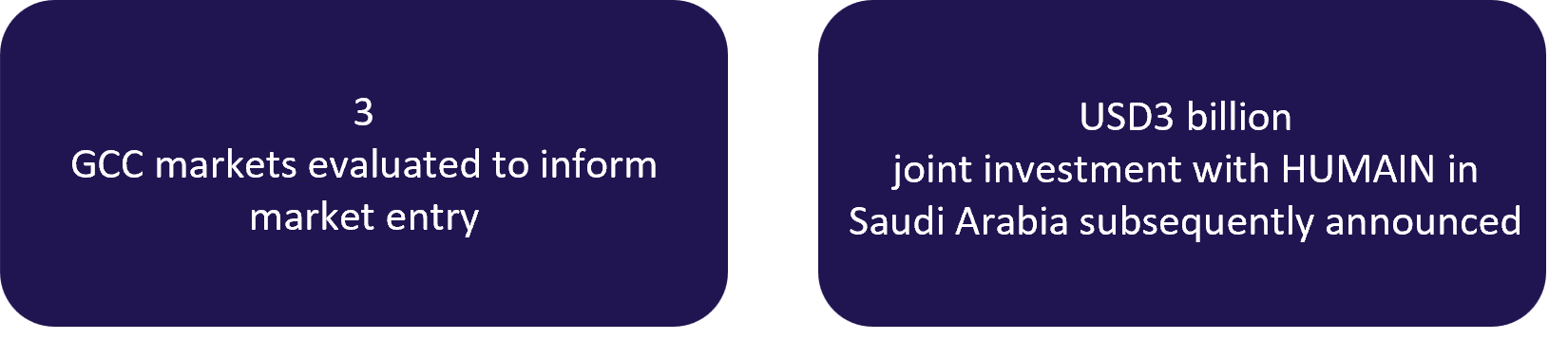
Following the engagement, Blackstone-backed AirTrunk announced a strategic partnership with HUMAIN in Saudi Arabia, including an initial investment of approximately USD3 billion in a data centre campus.
Authors
Rohan Dhamija
Managing Partner, Head of Asia–Pacific & Middle East
Johann Adjovi
Partner, expert in strategy
Sameer Gupta
Director
Arun Pai
Principal, expert in TMT strategy, fintech and AIRelated items
Tracker
Data centre database: Middle East and Africa August 2026
Article
Germany’s regional data centre opportunity: geographical selection and platform strategy will determine investor returns
Predictions
Accelerated investment in AI data centres in the GCC region will reach USD5–7 billion in 2026