
Communications infrastructure in 2026: fit for purpose?
08 June 2026 | Research
Article| Wireless Infrastructure| Data Centres| Fixed Infrastructure
“Communications infrastructure has never been more advanced. It has also never been under this much pressure.”

There has been significant and growing investment in communications infrastructure for the past 20 years, resulting in more fibre, more spectrum and better mobile coverage in most major markets. But without significant further investment, this infrastructure is no longer fit for purpose in the current context, for two interrelated reasons.
First, the range of sectors that depend on this infrastructure for critical operations (including finance, public safety, energy, transport, manufacturing and defence) has expanded rapidly, but its resilience has not kept pace with these sectors’ increasingly demanding requirements.
Second, the acceleration of AI usage is introducing new demand patterns, new investment cycles and fundamental changes to the way traffic flows across communications networks. Reliability and availability of communications infrastructure need another step change to keep pace.
Communications infrastructure is expanding in scope and complexity
Communications infrastructure is defined as any kind of networking or data centre fabric that supports commercial or public communications. It spans passive assets such as towers and fibre ducts; active networks including fibre, mobile and satellite, subsea and long-haul cables, edge and core data centres; and the layers of software that orchestrate traffic across them all. Digital infrastructure processes and stores data; communications infrastructure moves it.
Figure 1: Modern communications: a web of interconnected systems
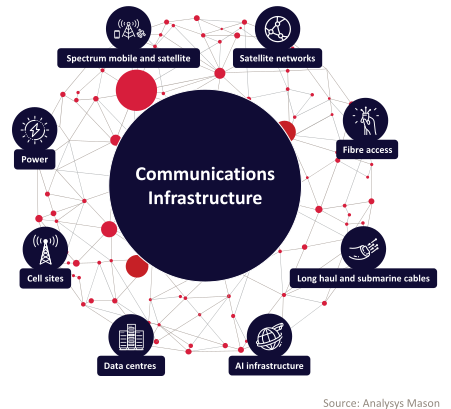
Communications infrastructure is a sprawling, interdependent set of systems that must possess three properties if the infrastructure is to hold.
- Ubiquity. Connectivity has to be available from any location: for example, a moving train, a rural hospital or a shipping container somewhere in the mid-Atlantic. Losing signal has far-reaching consequences, but in most countries, current coverage standards fall short of what is required for services that depend on strong connectivity.
- Reliability. Mobile networks in particular have a mixed record for reliable connections, and poor signals are becoming more serious. Financial trading platforms, emergency services and remotely operated machinery cannot tolerate a ‘best-effort’ connection; they need guaranteed response times.
- Capacity. Most countries worldwide have plentiful capacity thanks to extensive fibre roll-outs and increased mobile spectrum. However, AI is likely to create new capacity demands, but these will be concentrated in selected locations where there is heavy processing – and these may be difficult to anticipate. Operators that have not mapped these pressure points risk investing in the wrong parts of their network.
Dependency on public communications networks has grown
Most services that ran over public telecoms networks 15 years ago were not mission-critical. This has changed dramatically.
Public safety is probably the most striking case. In several countries, emergency services have moved away from dedicated systems onto standard telecoms networks. Finance has followed a comparable path: banks and trading firms that once invested heavily in proprietary connectivity now also route through public cloud and telecoms infrastructure.
Government and defence agencies have taken a similar approach, though with particular requirements around sovereignty and data access. Rail signalling, aviation systems, port logistics, utilities, manufacturing, commerce and payments also assume high-capacity, reliable connectivity, with very little tolerance for disruption.
Public communications networks now underpin both life-critical operations and the continuous functioning of large parts of the economy. An outage that lasts a matter of hours can cost many millions of dollars in lost business, create reputational damage that lasts years and even risk lives.
As infrastructure ownership fragment, the level of risk increases
Communications infrastructure is no longer just about fibre and mobile networks owned and run by telecoms operators. These networks are now intertwined with cloud and satellite assets, and ownership has become more distributed, split across operators, tower companies, hyperscalers, private-equity vehicles and specialist fibre and data centre businesses.
Wider ownership brings in fresh capital, which is sorely needed, but it also creates co-ordination risks. When an outage or security breach hits one part of the system, the effects can spread across networks and organisations with no involvement in the original failure.
This fragmentation creates consequential choices for everyone involved. Telecoms operators, satellite companies and infrastructure investors all face strategic decisions about the role that they play in an increasingly complex value chain.
AI will create new traffic patterns and pain points
Communications infrastructure is under growing strain
The pressures that telecoms operators face have become more numerous and complex, potentially outpacing improvements in connectivity.
Figure 2: Pressures on operators’ infrastructure investment models
| Pressure | Current state |
| New cycles of infrastructure and funding | Fibre has replaced much of the old copper network, and 5G is taking over from 3G, but all infrastructure eventually ages. Operators, whose revenue growth is largely flat, face a more rapid replacement cycle to support emerging technologies such as next-generation AI and quantum computing. A central challenge will be to make equipment last longer and become more sustainable. |
| Spectrum efficiency | Most operators hold enough spectrum for the next few years, and traffic growth is easing. The constraint has moved from scarcity to efficient utilisation, extracting more performance from bands that have traditionally been difficult to work with, or combining and reusing spectrum more effectively. |
| Cyber, climate and geopolitical threats | Attacks on networks are growing in scale and sophistication. Extreme weather threatens the physical infrastructure. Geopolitical instability is making investors hesitate. |
| Regulatory co-ordination | Telecoms regulators and those overseeing adjacent sectors, such as energy, operate largely in isolation from each other in most countries, while cross-border co-ordination on interoperability and standards has failed to keep pace with the internationalisation of networks and supply chains. |
Source: Analysys Mason
The requirements for resilience in critical operations add further pressures on infrastructure
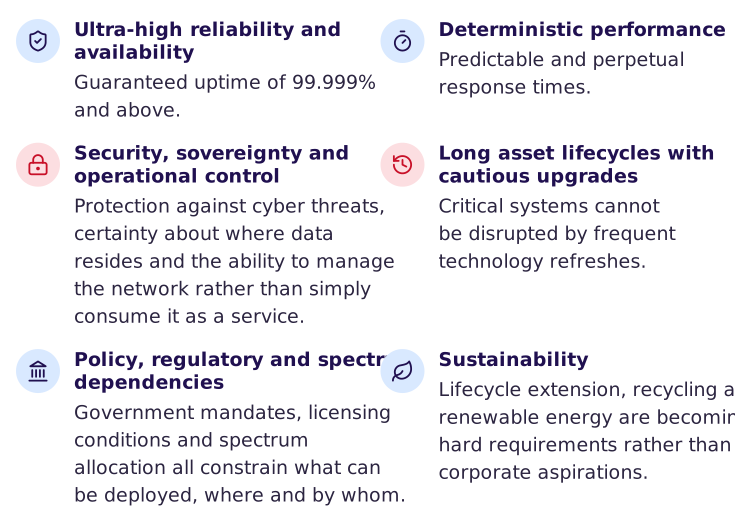
Ubiquity, reliability and capacity are baseline requirements, but critical operations demand significantly more. The level of resilience that users expect is quite different from what commercial telecoms networks have traditionally delivered. A public safety network or financial trading platform now requires the following capabilities.
Figure 3: Network requirements for resilience in critical communications
Source: Analysys Mason
The good news is that most countries do not need to replace the infrastructure that they have. The foundations, particularly on the fibre side, are largely in place. Instead, densification and enhancement should be the priorities for the next wave of investment.
Edge infrastructure is being revived by AI, driving densification
If data does not have to travel vast distances to be processed and sent back, there is less strain on the network and fewer points where something can go wrong. Edge infrastructure, which is made up of smaller, more distributed data centres and connectivity nodes located near the end user, is the most direct route to improving reliability and performance. AI greatly increases both the need and the business case for dense edge infrastructure.
Most countries have sufficiently solid central networks and data centres. What they lack is density at the edges and coverage in certain areas. Roadside and railside coverage remain poor across most countries in Europe, while rural connectivity is patchy in North America, for instance, and this impacts reliability.
Emerging technologies such as 6G, quantum computing and hybrid models are further changing infrastructure requirements
The demands placed on communications infrastructure are shifting from connecting people to cloud services towards something materially different: immersive applications, AI-driven processes and machine-to-machine communication at enormous scale.
These developments will be enhanced by emerging technologies that will enable new experiences, but they will also place additional strain on existing communications infrastructure. Technologies such as 6G and quantum computing will demand fresh investment as they become integrated into existing data centres and networks to drive new services and economics. For infrastructure owners, the risk is not any single technology; instead, it is the cumulative investment required to support all activities.
6G and new optical technologies will change networks’ footprints
6G is still 2 to 3 years from standardisation, but a broad outline of what the technology will deliver is emerging. It will embed AI and address 5G shortcomings around security and resilience. However, it may need a very different physical footprint, with far more base stations that are much smaller than traditional ones and inexpensive enough to go on any rooftop or street hoarding.
On the fixed side, next-generation optical technologies are extending the capacity and speed of fibre over long distances.
Quantum computing and next-generation security will be woven into the new communications fabrics
Quantum computing uses principles of fundamental physics to solve extremely complex problems more quickly than traditional computers. In communications, it can be used for massive-scale traffic optimisation. However, it also introduces security threats of an entirely new order, with the potential to break the encryption that current networks rely on. Quantum security is already being woven into data centres and the optical layer as a defence.
Hybrid network models will be essential as the requirements of criticality and AI grow
Perhaps belatedly, telecoms operators have acknowledged that no single network type will do everything well. A fibre connection offers unmatched reliability and capacity, but you cannot put fibre everywhere. Mobile provides coverage and mobility, but it has limits in remote areas. Satellite reaches places nothing else can but has relatively limited bandwidth.
Telecoms operators, satellite operators and investors must all rethink their role in the communications infrastructure value chain

Explore our latest insights on communications infrastructure
Author