
Network X: Central European operators show how market constraints can sharpen innovation
26 October 2026 | Research
Article | PDF | European Country Reports| European Quarterly Metrics| European Core Forecasts
"Telecoms operators in mature markets must generate more value from existing customers, assets and investments rather than rely on market expansion for growth."

Analysys Mason attended Network X 2026 in Vienna, Austria, in October 2026. Our discussions with A1 Hrvatska, O2 Slovakia and Turknet at Network X in Vienna showed how market constraints can sharpen operators’ strategic choices in relation to their core offerings. Rather than spreading investment across multiple initiatives, these operators are focusing on reliable connectivity, customer experience and opportunities that offer clear value for both customers and the business.
Telecoms operators in Central and Eastern Europe (CEE) have mature customer bases, face intense price competition and have limited scope for price increases. Most operate in relatively small markets, leaving little room for expensive diversification strategies. These constraints do not necessarily encourage innovation, but they do force operators to be more selective about where they invest: improving connectivity and customer experience, simplifying operations and prioritising initiatives that deliver measurable value.
Operators in CEE must generate more value from their existing customer bases and assets
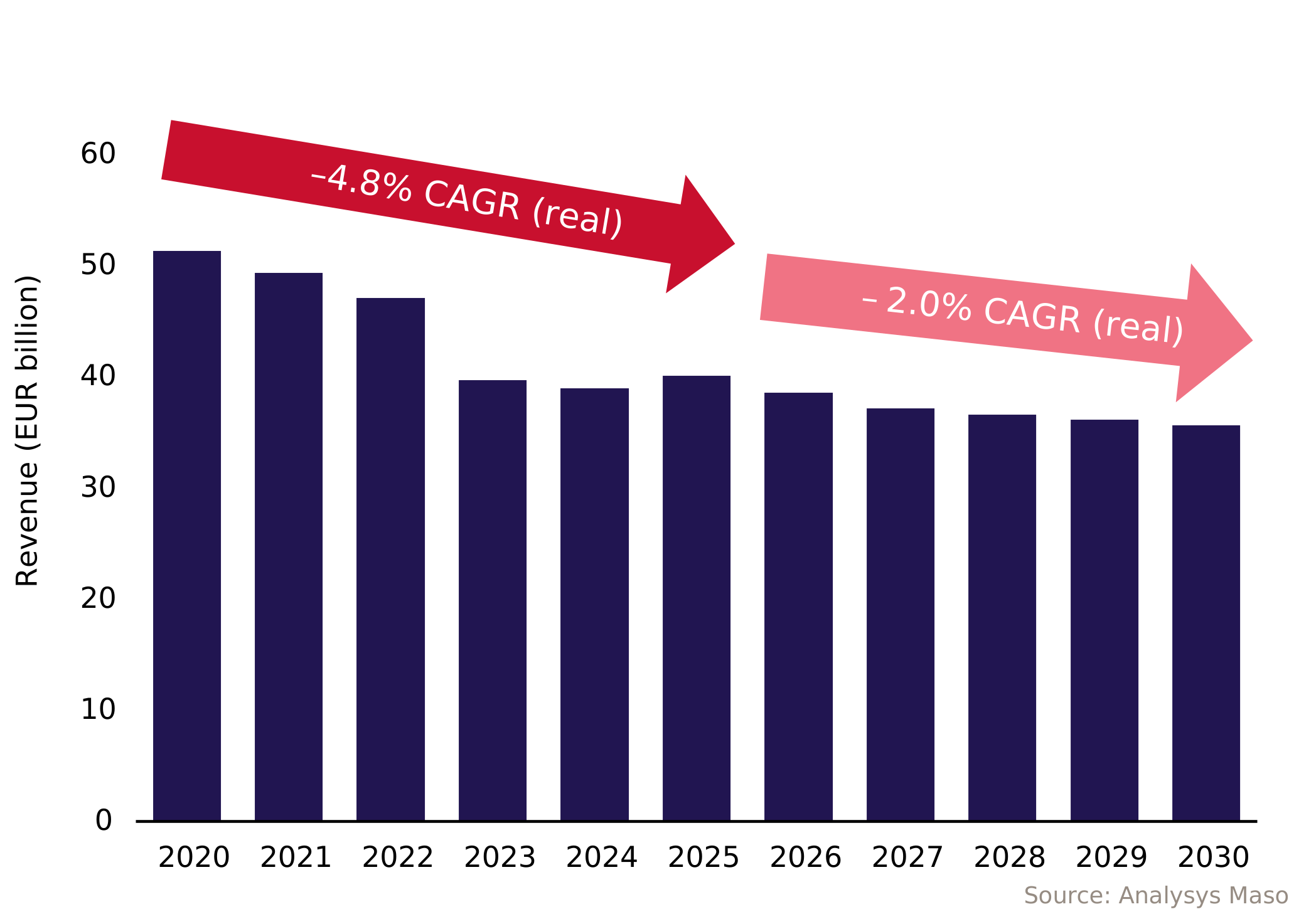
Analysys Mason’s data shows that core fixed and mobile service revenue in CEE grew at a nominal CAGR of 3.6% during 2020–2025.1 However, inflation-adjusted revenue declined at a CAGR of 4.8% over the same period, leaving operators to manage costs tightly simply to maintain margins.
Our Central and Eastern Europe telecoms market: trends and forecasts report projects a further real-terms revenue decline of 2% per year for the fixed and mobile markets during 2026–2030 (see Figure 1).
The number of mobile handset connections will grow only marginally in the most saturated markets in CEE, while broadband services offer greater scope for growth through fibre migration and higher-value packages. However, our forecast indicates that price increases and upselling will not fully offset inflation.
Operators therefore cannot rely on market expansion to deliver revenue growth. They must demonstrate tangible benefits to customers and generate better returns from existing assets.
Figure 1: Decline in core fixed and mobile service revenue, Central and Eastern Europe, 2020–2026
Operators in CEE are taking different approaches to innovation
The three operators below have adopted different models, but each has linked its technology choices to a focused commercial proposition.
Figure 2: A1 Hrvatska, O2 Slovakia and Turknet: challenges, actions and reported outcome
| Operator | Challenge, actions and outcome |
|
A1 Hrvatska (Croatia): an established challenger with its own fixed and mobile networks |
|
|
O2 Slovakia: a mobile challenger that became the market leader and expanded into fixed broadband by acquiring UPC |
|
|
Turknet (Turkey): a digital-first fibre challenger with a contract-free offer |
|
Source: Analysys Mason
Operators across Europe can learn from CEE operators’ disciplined approach to innovation
The common lesson from all three operators was not a particular technology or business model, but a disciplined approach to deciding where to invest and, just as importantly, where not to invest.
- Use market constraints to narrow the strategic agenda. Smaller-market operators prioritise connectivity, customer experience and operational efficiency rather than diversifying into multiple adjacent markets. The lesson is not to focus exclusively on connectivity, but to ensure that every investment delivers clear customer value.
- Simplify before automating. Applying AI to overly complex processes risks making existing inefficiencies worse, so operators should simplify products and processes before introducing AI. Turknet’s product model and O2 Slovakia’s partnerships illustrate how to reduce organisational complexity before introducing automation.
- Measure outcomes that customers value, not just deployment milestones. Successful operators track in-home experience, network quality, acquisition and retention rather than treating technology deployments as an end in themselves. A1 Hrvatska, for example, judged 5G success by whether customers experienced better in-home connectivity during peak seasonal demand, not by the number of sites deployed. Innovation programmes should start with a clear customer problem and commercial objectives, then measure progress against both.
- Reduce the distance between decisions and execution. O2 Slovakia benefits from shorter reporting lines and faster decisions, enabling rapid testing, launch and refinement. Larger operators can achieve similar agility by giving local teams clearer authority, faster approvals and greater accountability for results.
The lesson to be learned is not to copy Turknet, A1 Hrvatska or O2 Slovakia, but to recognise that constraints can force greater strategic discipline. As revenue growth becomes harder to achieve, operators that concentrate investment and management attention on the few initiatives that customers genuinely value may outperform those that pursue the largest number of opportunities.
Analysys Mason’s European Core Forecasts, European Country Reports and European Quarterly Metrics combine research and data to help clients understand the challenges and opportunities in the technology, media and telecoms sectors. Our regional market modules provide deeper insight into the challenges and opportunities specific to individual markets and regions.
1 For more information, please see Analysys Mason’s DataHub.
Article (PDF)
DownloadAuthor

Julia Martusewicz-Kulinska
Research DirectorRelated items
Article
BT’s TalkTalk acquisition solves one problem but leaves it with an older, dissatisfied base to win over
Country report
Czech Republic: state of the telecoms market 2026
Tracker
European quarterly metrics: Central and Eastern Europe 2Q 2026