
Sovereignty is here to stay in space defence spending
"Space defence spending will continue to grow in the coming years, but vendors will find that sovereignty places further constraints on opportunities."

Governments worldwide are increasing their spending on space-based defence capabilities as geopolitical fragmentation forces them to seek sovereign control over their assets. NATO members and partner countries1 have awarded over USD51 billion in total contract value on space-based defence in 2026, up from USD20 billion in 2025.2 Early investment this year included procurement of satellite communications (satcom) and Earth observation satellites for secure, reliable access to data and networks. However, the largest portion of spending has gone to missile early warning (MEW) and space domain awareness (SDA) as governments and militaries work to expand monitoring capabilities and increasingly leverage space for defence purposes.
Sovereignty will remain a dominant theme in space spending through 2027 and beyond, and this presents an opportunity for vendors selling in national markets.3 However, the trend will challenge vendors seeking to sell internationally, especially given changes in government, delays in space defence programmes and distinct national preferences.
The US Golden Dome initiative is powering sovereign spending on MEW
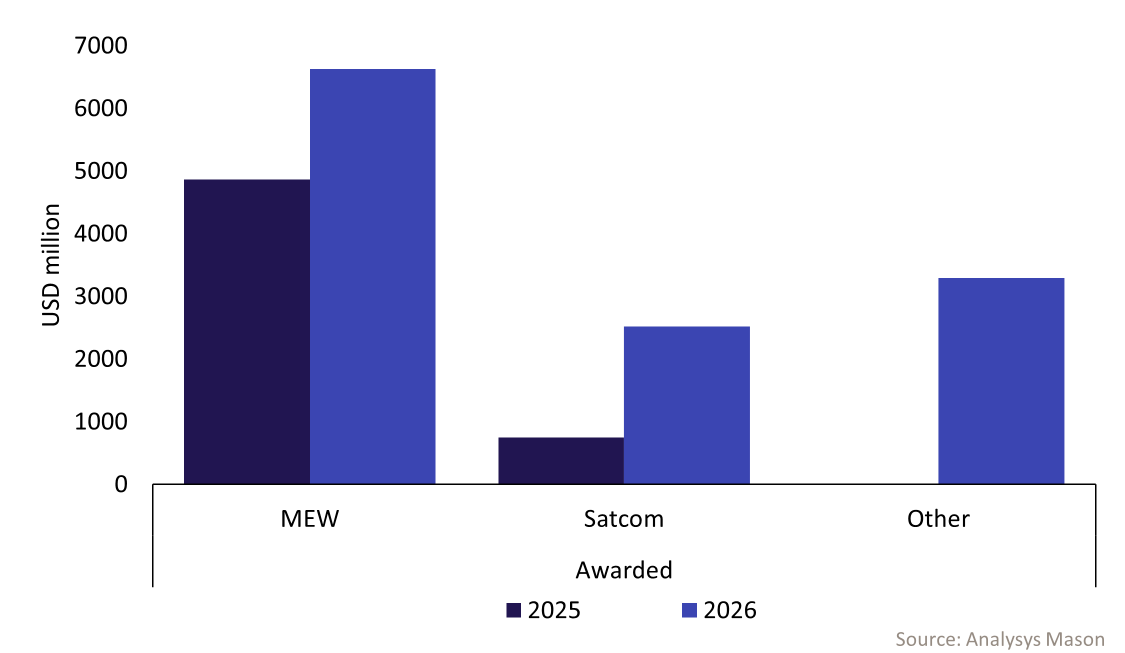
MEW was a major growth area in 2025 following the announcement of the US Golden Dome initiative. In its nascent stage, new awards from the initiative only supported existing programmes such as the Proliferated Warfighter Space Architecture (PWSA). However, the Golden Dome remains the driving force behind MEW spending worldwide, and the initiative awarded its first original programmes in 2026 (Figure 1), such as SpaceX’s contract for the USD4.1 billion Air Moving Target Indicator (AMTI). Outside of the USA, geopolitical tensions are driving European governments to develop their own MEW capabilities. The Franco-German Joint Early Warning for a European Lookout (JEWEL) programme, as part of the EU ‘Odin’s Eye’ project, is the prominent effort in Europe. However, no public contract announcements have followed the programme’s inception in 2025. This reflects how, despite growing interest and investment, MEW is still a new market. Outside of the USA and Europe, vendors should expect little opportunity in the area in 2027.
Figure 1: Golden Dome-awarded contracts in the public domain, by application area
The Golden Dome presents a large opportunity for US-based vendors. However, following the US midterm elections in November 2026, funding for the initiative will face greater political scrutiny. To date, the bulk of the approximately USD180 billion in funding has been from Congressional reconciliation funds through 2029, with a requested budget of USD17 billion for FY2027. The initiative’s scope remains poorly defined, making its total funding requirements uncertain, and the new Democratic majority in Congress is likely to press for a funding ceiling to prevent costs from spiralling. Therefore, vendors should not view the Golden Dome as a guaranteed entry point into the US defence market.
The initiative’s Scalable Homeland Innovative Enterprise Layered Defense (SHIELD) contracting vehicle is designed to broaden procurement beyond traditional prime contractors through rapid prototyping and purchasing from non-traditional defence companies. This has created a pool of over 3000 vendors. However, SpaceX has won half of the roughly USD12.5 billion awarded publicly through SHIELD, which contradicts the aims of the contract vehicle.4 Accordingly, access to SHIELD should not be confused with a guarantee of contract revenue. Sub-contracting opportunities still exist for vendors, and new efforts will emerge. However, SpaceX, as the leading US space defence prime, is likely to remain the dominant market player.
SDA is an emerging opportunity, but sovereignty will limit vendors’ reach
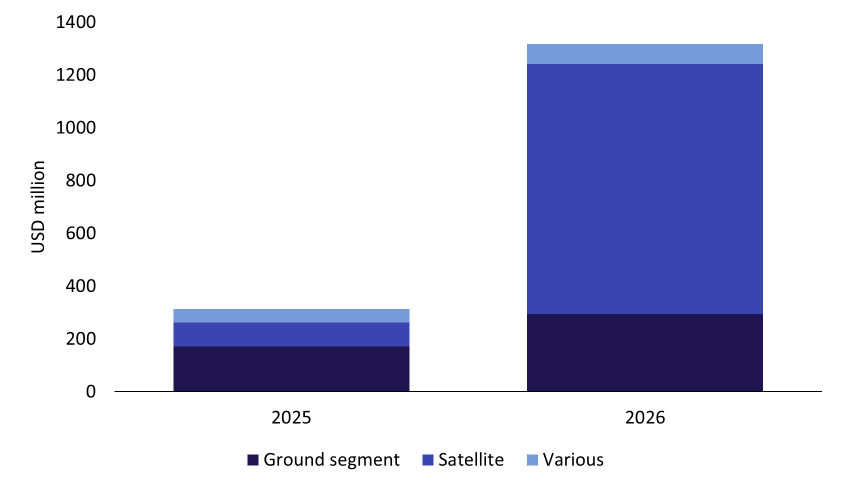
SDA spending grew massively in 2026 (Figure 2) as nations prioritised the protection of sovereign assets and hostile acts against satellites increased. Spending will continue to grow while geopolitical tensions remain acute, creating demand for SDA satellites and associated technology. Recent incidents such as the alleged hostile operations by Russia against an ICEYE satellite will add further impetus. Due to the sovereign interest in SDA, nations will seek control over the protection of their assets in this area. Therefore, SDA service providers will be constrained when entering the market. Vendors, in turn, are likely to be limited to supplying hardware and other core technologies. Nonetheless, as hostile actors increasingly target commercial satellites that support defence, the operators that vendors partner with could become customers of SDA services.
Figure 2: NATO year-on-year spending on SDA in the public domain, by segment
Countries looking to reduce their reliance on foreign providers are fuelling a surge in sovereign satcom spending
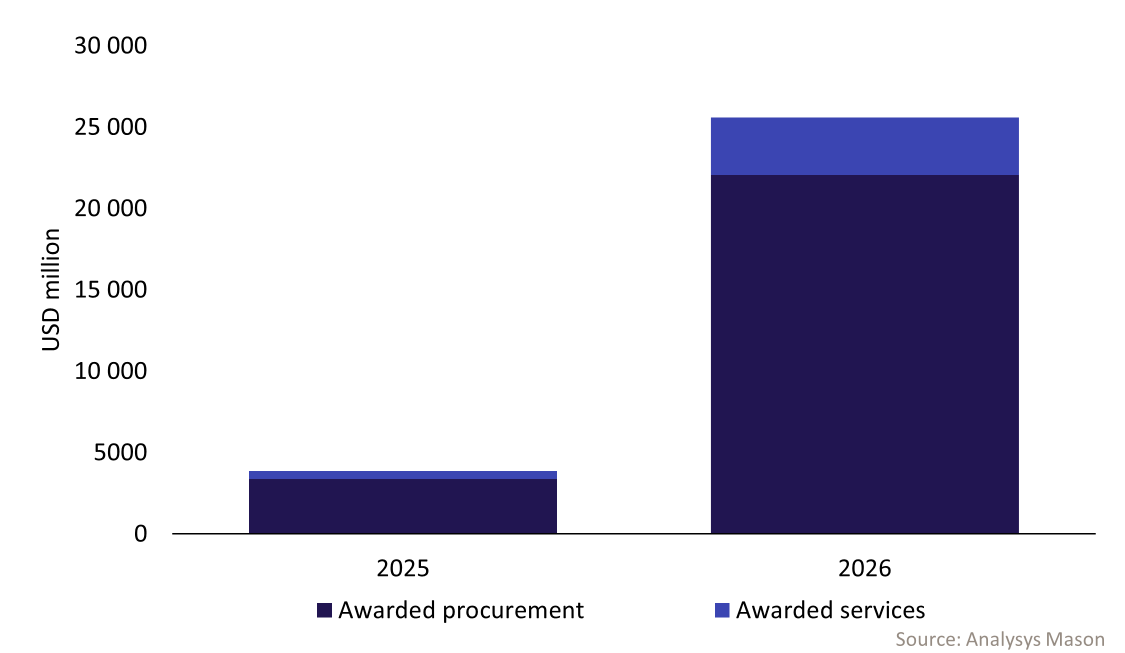
The value of awarded satcom contracts rose from USD8 billion in 2025 to USD30 billion in 2026, driven mainly by European demand for sovereign assets (Figure 3). These amounts exclude IRIS2 because it is primarily a civilian constellation, even though it is also used for military purposes. The flagship European defence satcom effort behind the increase in spending is Germany’s USD9.2 billion SATCOMBw4 programme, which aims to develop a constellation of up to 100 low-Earth orbit (LEO) satellites. There are signs that European countries may shift away from IRIS2 for military satcom, and towards sovereign assets for primary capabilities. The ICEYE–Nokia partnership and France’s interim service contracts with Eutelsat indicate this shift, representing activity beyond IRIS2. Outside Europe, the USA continues to issue satcom service contracts alongside Golden Dome-related satcom elements. Canada is pursuing the Enhanced Satellite Communications Project – Polar (ESCP-P), while Australia has restarted SPA9102. Japan has also started its Next Generation Defence Satellite Communication System.
Figure 3: NATO-awarded satellite contracts in the public domain, procurement versus services
Satcom is one of the major sovereign requirements and will continue to be so. Countries worldwide want to control their satcom assets, given the fragmented geopolitical landscape and the risk of relying on foreign providers for critical communications, as highlighted by Starlink outages in Ukraine. Vendors are increasingly finding that robust anti-jamming and spoofing capabilities are a requirement for success, and service providers increasingly must add explicit service-continuity commitments in their service-level agreements (SLAs). These include commitments such as guaranteed minimum capacity, levels of prioritisation (for example, government traffic receiving priority during surge events in a crisis) and no shutdown of service access clauses.
Sovereignty will remain a crucial aspect of satcom satellite procurement in 2027, especially in Europe. Countries will continue to demand greater control over essential space capabilities and seek to reduce their reliance on foreign providers. Political change in the USA and elsewhere will not necessarily ease sovereignty-related procurement requirements. Vendors can expect procurement processes to increasingly favour domestic and regional suppliers, alongside industrial offsets.5 Sovereignty is now a condition of market entry, and vendors that weigh the real profitability of each opportunity against its access requirements will be the ones that win.
To further understand and explore the issues raised in this article, contact the author, Alexander Clark, who leads Analysys Mason’s Defence and Sovereign Space programme. The Defence and civil government spending in space database, from which the datapoints in this article are taken, is a pillar of the programme’s research. Full access to the database is permitted to subscribers to the programme.
1 NATO partner countries include Australia, Colombia, Iraq, Japan, Mongolia, New Zealand, Pakistan and South Korea.
2 See Analysys Mason’s Defence and civil government spending in space database.
3 See Analysys Mason’s Sovereignty in space report.
4 SpaceX is the prime contractor on AMTI, the Space Data Network and smaller contracts.
5 Industrial offsets are where a national government requires a foreign company to provide certain economic benefits to the nation.
Article (PDF)
DownloadAuthor

Alexander Clark
Senior AnalystRelated items
Article
A Democratic Congress will have a significant impact on the US space industry… and SpaceX
Tracker
Defence and civil government spending in space database November 2026
Case study
Proliferated LEO satellite-based services: status and development