
European sovereignty-led spending will force vendors to be more selective about opportunities
18 September 2026 | Research
Article | Article (PDF) | Defence and Sovereign Space | Space | Governments & Regulators | Security & Resilience
"Sovereignty is creating barriers that will limit foreign vendors’ opportunities and erode profitability."

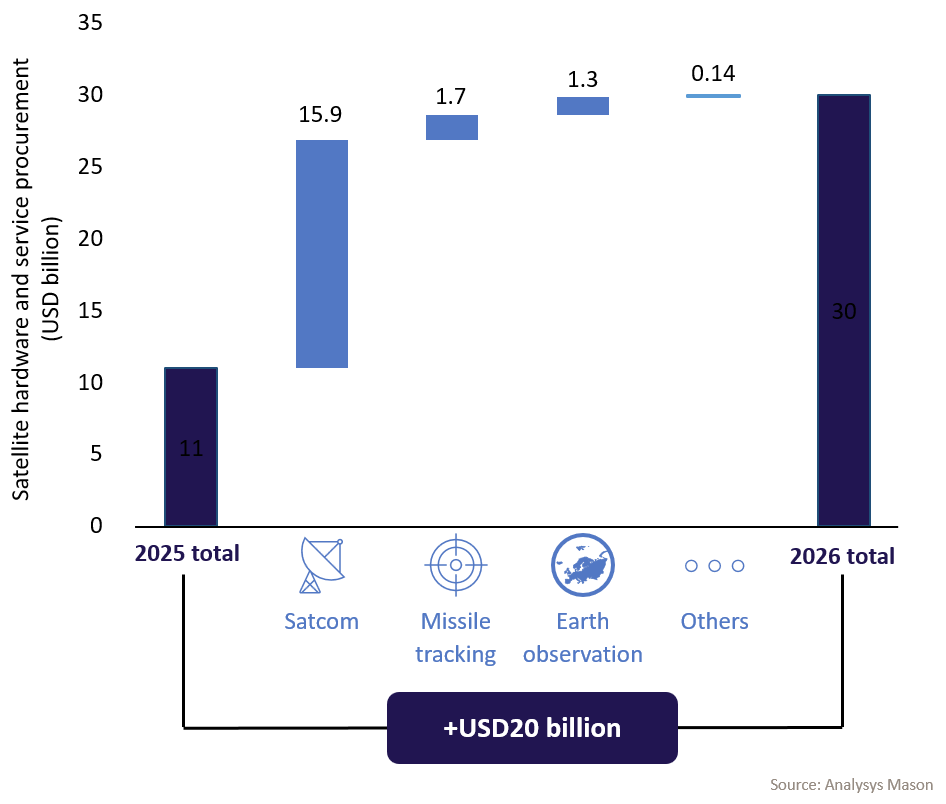
Government and military spending on space has risen rapidly in the last year. The value of NATO procurement contracts alone has grown by approximately USD20 billion (Figure 1). Geopolitical tension and economic pressure, including from the the USA–Iran conflict, the war in Ukraine and the USA’s inward focus, are driving nations to pursue stronger independence through national space capabilities. This trend of ‘sovereignty’ presents a strong opportunity for vendors to cater to growing demand for satellites, services and related hardware. However, these same factors that drive sovereignty spending are also pushing governments towards more nationally focused procurement. Europe is a prime example, where 98% of space-related government defence spending since 2025 has gone to European vendors. As such, sovereignty represents an opportunity and a challenge for vendors aiming to serve addressable satellite markets worldwide.
Vendors should treat sovereignty-led space spending as a selective growth opportunity rather than a fully open market. European vendors should prioritise countries that use mixed or regional procurement models, especially smaller economies that need external capability and expect local industrial development in return. Vendors outside Europe should focus on partnerships, joint ventures, technology transfer and local supply chain commitments to improve market access. They should carefully assess whether these requirements will reduce margins enough to outweigh the value of new contracts.
Figure 1: NATO defence hardware and service procurement
Europe will be the defining test case for sovereignty-driven space spending
European spending on space, especially spending related to defence capabilities, will continue to increase over the coming years, driven by geopolitical instability and a desire to reduce European reliance on US capabilities. Over the last 2 years, countries have announced large defence investment plans, identifying space as a critical capability. Major examples include the following.
- Germany announced a USD40 billion investment in space-related defence projects for 2026–2030.
- France allocated an additional USD5 billion to its existing space defence budget of USD7 billion for 2024–2030.
- In September 2026, the UK announced that it would spend USD10 billion on space by 2030.
Most of this spending will remain within Europe. However, not all countries have the national industrial base to scale to meet government capability needs quickly, such as new satellites or space services. This will present opportunities for European vendors within the region, although these opportunities will increasingly require specific approaches to market, such as establishing local factories and using local supply chains, that will cut into profitability due to greater capex and operational costs. This will make large spending initiatives, such as Germany’s USD40 billion investment by 2030, less profitable than they appear.
A desire to reduce reliance on US capabilities and industry ultimately drives Europe's push for sovereignty. The IRIS2 programme is the prime example of Europe distancing itself from the USA: it offers a direct answer to SpaceX’s Starlink, with participating vendors being exclusively European. Furthermore, governments are displaying a clear preference towards regional vendors for satellite procurement. The last couple of years have seen a wave of first-time defence satellite procurements by European states, with Finnish ICEYE receiving eight contracts in 2025 alone. On average, European countries are awarding 40% of opportunities to native companies. In practice, the approach differs from country to country, with governments pursuing sovereignty via three different spending models that have different implications for vendors (Figure 2).
Figure 2: European sovereignty spending models
| National model | Mixed model | Regional model | |
| Definition | Strong investment in national vendors to ensure security and to develop capabilities | A combination of national and regional models, depending on the priorities and capabilities of the country | Preference for semi-local vendors for specific capabilities. Local vendors cannot yet meet national requirements. Countries are beginning to require foreign vendors to help establish local capabilities through technology transfers and joint ventures. |
| Examples |
During 2025–2026:
|
During 2025–2026, the UK has split its spending 50:50 between national and regional models, with preference shifting from US- to European-led regional partnerships. | The Netherlands and Portugal have overwhelmingly relied on regional players. However, both have emphasised a desire to establish a native space industry. |
| Advantage | Excellent opportunities for national vendors | Model most open to different kinds of vendors | Most lucrative opportunity for regional and foreign vendors |
| Disadvantage | Forces foreign vendors out or into sub-contracting activities | Strategies become diverse and difficult to scale | Technology transfer threatens foreign participation in the long term |
Source: Analysys Mason
For foreign vendors, sovereignty will create barriers to entry, capability and profitability
Foreign vendors are facing a rise in barriers to entry in the European market, predominantly relegating them to sub-contracting activities. European countries are implementing these barriers as soft industrial policies, including requirements to use local supply chains, the establishment of local factories and a minimum level of native employee participation.
For US vendors, these barriers extend beyond soft industrial policies: they nearly eliminate the opportunity to enter the market as primes. In addition, further challenges are beginning to emerge for vendors seeking sub-contracting roles. Foreign vendors will likely see recent announcements, such as the German USD40 billion defence space capability investment, as a large opportunity. However, rising barriers will ultimately erode profitability.
Ultimately, European sovereignty will see competition sharply rise within the market as the European space industrial base grows, with non-European companies having the most to lose. For vendors, success in Europe will increasingly depend on being more selective in markets, and pursuing partnerships and opportunities that align with short-term access and long-term strategic objectives.
To discuss the issues raised in this article, please reach out to Alexander Clark. Further information on sovereignty, including a definition of sovereignty, the driving trends and business impacts for each major space application, is available in Analysys Mason’s Sovereignty in space report. The Defence and civil government spending in space tracker details the major programmes at the heart of sovereignty.
1Analysys Mason’s Sovereignty in space framework report outlines a definition of sovereignty in relation to space and helps vendors assess how sovereignty is taking shape across each space application.
2Analysys Mason’s Defence and civil government spending in space tracker is an extensive database of contractual and budgetary information that is regularly updated.
Download
Article (PDF)Author