
Moon base plans will push back the lunar market opportunity
"NASA’s new plans for a Moon base will boost the lunar economy with USD20 billion of funding contracts, but companies must brace themselves for technical challenges and timeline delays."

All eyes have returned to the Moon following the NASA-led Artemis II mission in April 2026, which marked humanity’s first lunar flyby since 1972. This renewed activity has intensified the focus on opportunities in the emerging lunar market, mainly driven by government funding and supported by increasing involvement from commercial players. However, delays to the Artemis programme and changes to its architecture are increasingly pushing large-scale lunar activity into the 2030s, which will create challenges for companies dependent on near-term growth.
The lunar market remains largely government-led; even many commercial missions anticipate government as a direct or indirect customer. Analysys Mason’s Lunar missions: trends and analysis 2026–2035 identifies 116 planned missions over the next decade, of which 64 are government-led. However, commercial activity is expanding, particularly in the USA, where companies are leveraging programmes such as Commercial Lunar Payload Services (CLPS) to fund technology demonstrations, with the aim of achieving long-term commercial viability.
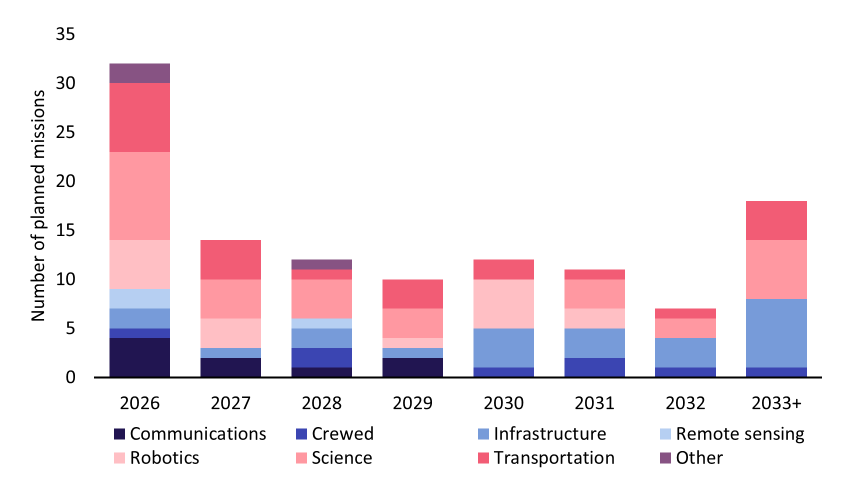
Much of this activity depends on the assumption that Artemis will proceed broadly as planned. Originally, its missions aligned with the Lunar Gateway, which was NASA’s longstanding plan to build a space station in lunar orbit by the early 2030s. However, persistent delays, funding uncertainty and major changes, including the cancellation of the Lunar Gateway, are undermining confidence in Artemis timelines. A large proportion of infrastructure, transportation and science missions are scheduled for the post-2030 later stages of the programme (Figure 1). However, further delays to Artemis, which appear likely, will push the scaling of the lunar economy deeper into the 2030s and challenge companies reliant on near-term growth.
Figure 1: Planned lunar missions, by vertical
Source: Analysys Mason
Artemis programme changes and HLS delays add uncertainty for the North American lunar market
NASA has outlined revised plans: Artemis III is targeted for mid-2027 but will be scaled back to allow commercial landers from SpaceX and Blue Origin to be tested. A crewed landing is now planned for Artemis IV, officially scheduled for early 2028, with subsequent missions occurring approximately annually.
A programme committed to later lunar surface missions would grant the security operators and partners need to plan their strategies. However, this timeline is in jeopardy: neither of the Human Landing System (HLS) commercial prototypes under development by SpaceX and Blue Origin are ready. SpaceX’s Starship HLS depends on unproven in-orbit refuelling infrastructure and on the successful development of the Starship rocket. To keep things on track, NASA has already reduced its Artemis III ambitions to a low-Earth orbit (LEO) mission, removing refuelling, but this capability must still be demonstrated before Artemis IV. Blue Origin is also under pressure following the recent New Glenn test-fire explosion, which damaged its only launchpad and grounded the vehicle needed to validate its Blue Moon landers. As a result, the company’s readiness for Artemis timelines is increasingly in doubt.
NASA has been making sweeping strategic programme changes amid the anticipated programme delays. It has cancelled plans for the Lunar Gateway and redirected investment towards developing a lunar base architecture by 2032. This shift opens up new opportunities and contracts, but a drastic change in plans also adds new costs and creates the potential for further delays.
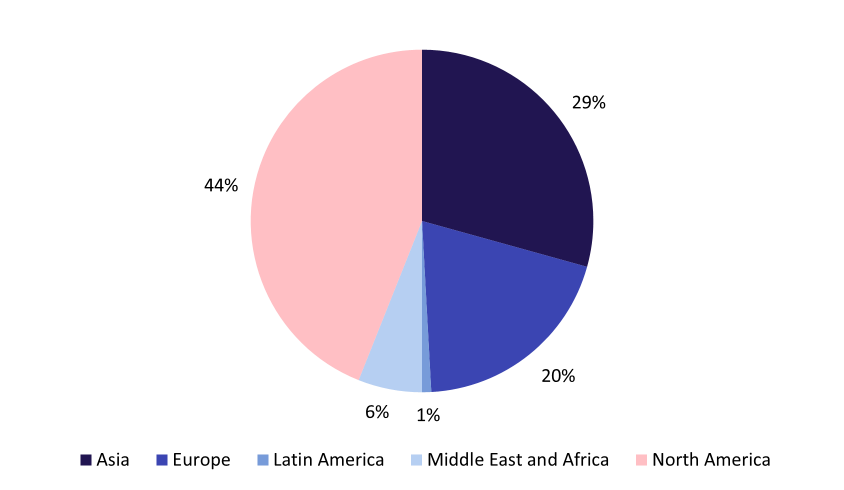
Policy uncertainty is another a risk factor: Artemis’s direction continues to evolve in response to political priorities. The USA is responding to competition from China and Russia, whose International Lunar Research Station (ILRS) programme is being developed in parallel to the US Moon effort. In fact, North America accounts for only around half of the lunar missions planned over the next decade (Figure 2). For a full list of announced and upcoming missions, see Analysys Mason’s Lunar Missions Tracker.
Figure 2: Planned lunar missions, 2026 onwards, by region
Source: Analysys Mason
CLPS expansion will be a primary route for new actors to get involved in lunar development
NASA’s lunar base plans will increase funding across the ecosystem. At least USD10 billion is expected for each of the three planned programme phases: Learn, Test, Build (2026–2029), Early Habitation (2029–2032) and Permanent Operations (2032+). Opportunities span transportation, communications, positioning, navigation and timing (PNT), as well as emerging areas such as resource utilisation and habitation.
CLPS remains the most accessible entry point for commercial players. Established in 2018, it allows NASA to procure payload delivery services from commercial providers with reduced oversight and higher risk tolerance. It has already supported missions by Intuitive Machines, Astrobotic and Firefly Aerospace, and includes 13 eligible companies. NASA plans to increase CLPS funding from USD2.6 billion to USD4.2 billion, with USD1.6 billion to be allocated within the next 2 years, ahead of the current contract’s expiry in 2028. A follow-on ‘CLPS 2.0’ programme is expected to expand this further.
This creates a near-term opportunity for commercial participation. However, most planned missions remain small-scale or one-off, which limits revenue potential. High failure rates (demonstrated by previous CLPS missions) also increase risk, as does reliance on NASA funding.
The logistics challenge is also significant at the system level. Lunar base development will require routine in-orbit refuelling and large-scale mass transport to orbit, which are not yet proven. Launch capacity is already under strain from broader space infrastructure demand. The Artemis architecture is therefore structurally dependent on Starship as the primary enabler of high-volume lunar logistics. Its payload capacity makes it a critical enabler of large-scale lunar logistics, and delays to its development are already pushing timelines further out. This reinforces uncertainty across the entire lunar market.
Artemis uncertainty is forcing a reset in investment strategies and business models
Investment conditions in the lunar sector are challenging. Reliance on NASA remains a concern, particularly as the agency shows signs of reconsidering elements of its commercial-first approach. Programme delays translate directly into funding risk and lost revenue for companies focused exclusively on the lunar market.
As a result, companies are diversifying into adjacent markets. Many are expanding into LEO services, such as in-orbit transport and servicing, or targeting defence demand where technological overlap exists. These players are adapting technologies developed for lunar applications for broader use cases, including robotics and resource utilisation.
The lunar market is likely to develop more slowly and be more concentrated than previously anticipated. Government demand will continue to dominate, and competition for contracts will intensify. Commercial opportunities will persist but will be more structured and constrained. The main challenge for stakeholders will be managing the transition period. Success will depend on balancing long-term market positioning with near-term commercial viability.
Analysys Mason’s Emerging Space Applications programme explores the development and utility of satellite technologies and infrastructure beyond traditional satellite manufacturing and launch. Coverage includes in-orbit services, lunar markets and new technologies such as optical satellite communications technology. Market sizing, supply, demand, pricing and the potential disruption of satellite manufacturing, launch and operations are key areas of focus.
Article (PDF)
DownloadAuthor