
Operators must look beyond speed and price to differentiate their business broadband services
"The strongest business broadband propositions charge for stronger resilience, better service quality and innovative features, rather than simply replicating what competitors are doing."

Business broadband revenue growth is facing increasing pressure as consumer services improve and as low-cost providers expand their business offerings. Analysys Mason’s analysis of ten operator case studies suggests that premium levels of resilience, higher service quality and embedded network capabilities offer more sustainable differentiation than broad price discounting.
Telecoms operators need to protect market share without weakening ARPU
The business broadband market faces pressure from several directions.
- Consumer services are getting better. Bandwidth is increasing, and symmetric1 services are available from many operators. Analysys Mason’s 2025 business survey found that more than 40% of small businesses use consumer-grade fixed data connectivity for at least some of their needs.2
- Low-cost and no-frills new entrants are disrupting the market. They often focus on consumers, but some also target the business market, including Iliad (France and Poland), Digi (Romania) and Aussie Broadband (Australia). Even in countries where there is little direct competition from these players in the business market, aggressive low pricing in the consumer segment increases competitive pressure.
- Multiple network providers are competing to gain customers. In high-demand areas, multiple fibre operators are often deploying infrastructure, each wanting to drive scale. Fixed-wireless access (FWA) and satellite operators also want to utilise spare capacity by adding more customers.
As a result, Analysys Mason forecasts that the total business broadband market will grow at below-inflation rates in most countries. Operators therefore need propositions that protect market share without sacrificing ARPU, and that create credible opportunities to cross-sell mobile, security and other business services.
Operators should use resilience and service quality to create meaningful premium tiers
Analysys Mason’s business surveys indicate that reliability and fault response is a major influencing factor alongside price for small businesses’ choice of supplier for telecoms services. This is reflected in the business broadband offers of the ten operators included in our case studies report. Most of these operators offer mobile back-up and defined repair commitments with business broadband services, whereas only a small number provide these features with consumer broadband (Figure 1).
Figure 1: Number of operators in Analysys Mason’s case studies that offer mobile back-up or repair commitments for their business and consumer broadband services
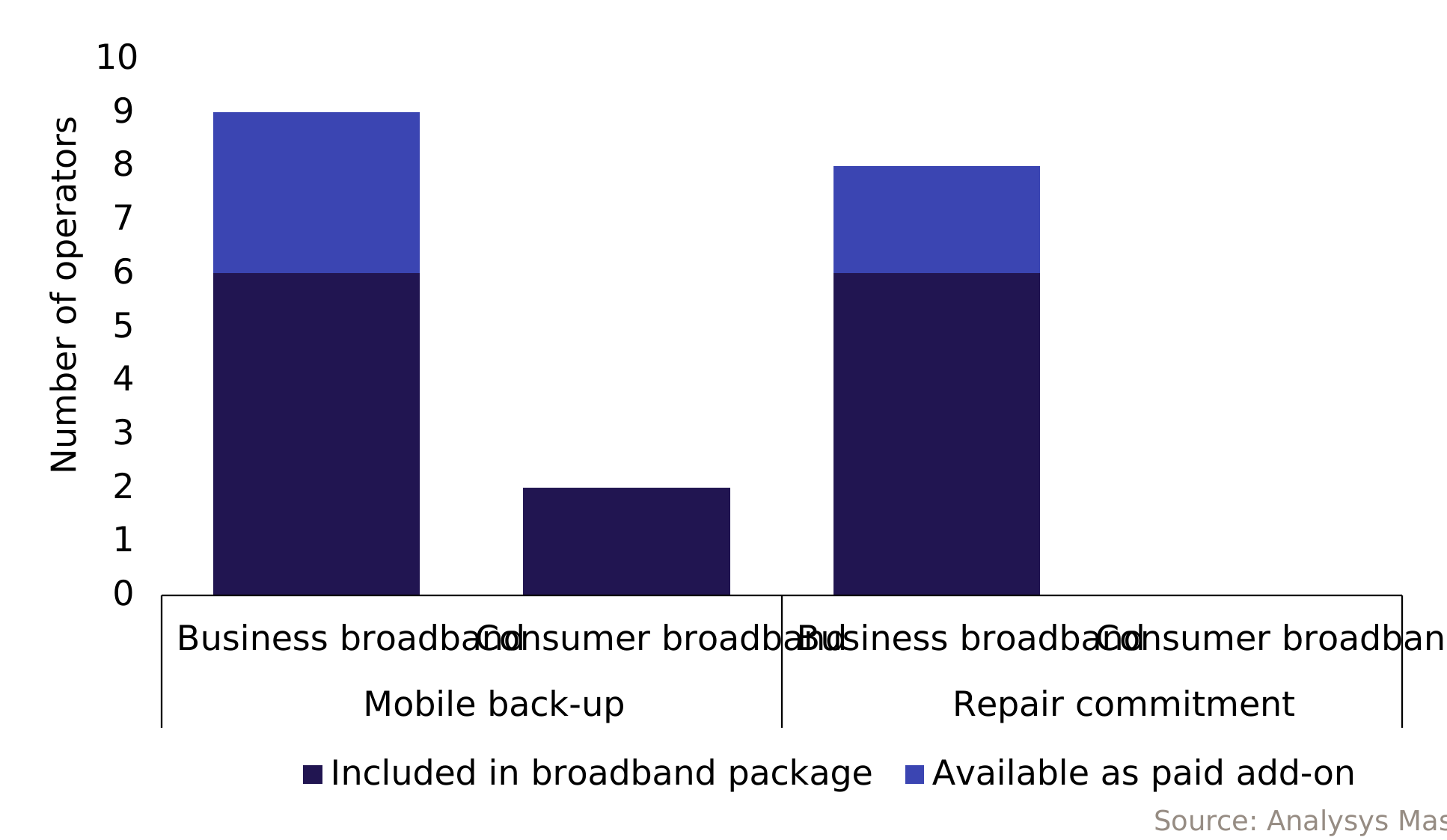
Operators also differentiate in terms of the quality of these commitments. For example, most operators provide repair timeframe commitments of between 4 and 8 hours, whereas others only offer next-working-day resolution.
Not all small businesses require high levels of resilience. In Switzerland, for example, Swisscom charges an extra CHF15 (EUR16) a month for improved back-up and repair commitments on its broadband services. This limits its obligations to customers that value the additional resilience and enables it to boost ARPU. Similarly, Vodafone (UK) and Telstra (Australia) only include mobile back-up on premium plans. KPN (Netherlands), Play (Poland) and WINDTRE (Italy) also charge additional fees for either mobile back-up or improved repair times.
Innovative network capabilities can provide operators with more durable differentiation and support ARPU growth
Many operators differentiate their business broadband services from consumer broadband with features such as static IP addresses, business voice services and access to third-party productivity and security applications. These are all valued by small businesses but are widely available and have limited potential to differentiate operators from their peers.
Examples of more distinctive features of business broadband services that can provide more durable differentiation and support ARPU growth include:
- Swisscom’s beemNet, an embedded network security solution that protects connected devices and company sites. Adoption reached more than 100 000 users across fixed and mobile networks by mid-20263
- Community Fibre’s ‘no peak-time slow down’ guarantee on its fibre network in London
- Exetel’s My SpeedBoost, which enables customers to temporarily increase their normal bandwidth for 24 hours, for up to 5 days per month.
The most-effective differentiators are those that operators can embed in the connectivity service and that competitors cannot easily reproduce with third-party add-on services.
Price discounts should be tied to multi-service adoption or premium services
Most operators want to avoid significant price discounts. Portfolio-wide discounts can help new entrants to disrupt an established market, but they are only sustainable if they are based on a lower cost base than competitors. Price discounts may also attract more price-sensitive customers and may offer only limited protection against future churn.
However, there are at least a couple of ways in which price discounts can create lasting value for operators.
- Increasing the number of fixed–mobile converged (FMC) customers. Several operators offer mobile discounts to existing fixed broadband customers, or fixed broadband discounts to mobile customers. Small businesses that buy fixed and mobile services from the same provider generate higher revenue per account and are less likely to churn, according to the operators that we spoke to.
- Driving customers onto premium high-bandwidth services. Some operators reserve the largest discounts for high-bandwidth services. This can help to attract businesses with the greatest bandwidth requirements and the strongest willingness to pay.
Discounts should be linked to behaviours that enhance account value or improve retention, rather than used simply to reduce the headline broadband price.
None of these strategies are mutually exclusive; most operators should adopt a multi-pronged approach
The small business market is diverse in its needs. Operators should therefore use a combination of different approaches to address their requirements. Consumer-like packages can be effective for businesses with simple needs but will do little to improve ARPU. Premium packages should focus on addressing core business requirements such as business continuity, secure connectivity, and 24/7 customer support.
At times, there has been a tendency for operators to think about tiering and value-added services in terms of offering extra products such as third-party applications. However, operators are likely to create more-defensible value by offering higher service quality, stronger reliability commitments and distinctive network capabilities.
Subscribers can learn more about the approaches of operators mentioned in this article in Analysys Mason’s recent reports: Differentiating fixed connectivity for small businesses: effective strategies for telecoms operators and Differentiating fixed connectivity for small businesses: case studies and analysis.
1 Historically, most consumer broadband has been asymmetric (with lower download speeds), whereas business broadband has been symmetric. That distinction no longer exists in many operator portfolios.
2 Businesses with 10–49 employees. Based on a sample of 264 businesses in the Germany, Singapore, UK and the USA.
3 Swisscom (August 2026), Q2 2026 results: Investor and analyst presentation.
Article (PDF)
DownloadAuthor

Catherine Hammond
Research DirectorRelated items
Article
Where will US digital infrastructure capital go next?
Article
Monetisation of the AI value chain must reflect both the benefits of AI and the underlying cost structures
Article
Edge AI: why telecoms operators should look again at edge computing