
Sustainability regulations will increasingly impact digital infrastructure investment decisions
"Sustainability regulation is reshaping digital infrastructure investment decisions; companies that fail to keep up with new requirements risk delayed projects, higher compliance costs and restricted market access."

Sustainability regulation is expanding in both geographical coverage and scope. More jurisdictions are imposing regulations that directly affect large-scale digital infrastructure investments.
Analysys Mason’s Sustainability regulations and frameworks tracker reveals that more than 60 jurisdictions have introduced mandatory sustainability regimes affecting digital infrastructure and service providers. Governments in a further 14 jurisdictions have proposed mandatory sustainability regulations and frameworks.
As more countries introduce rules, and as existing rules become more detailed, companies face growing pressure across reporting, procurement, product design and deployment, supplier data management and asset performance. This article examines recent regulatory and framework developments and what they mean for digital infrastructure and services companies.
Sustainability reporting rules are spreading beyond Europe
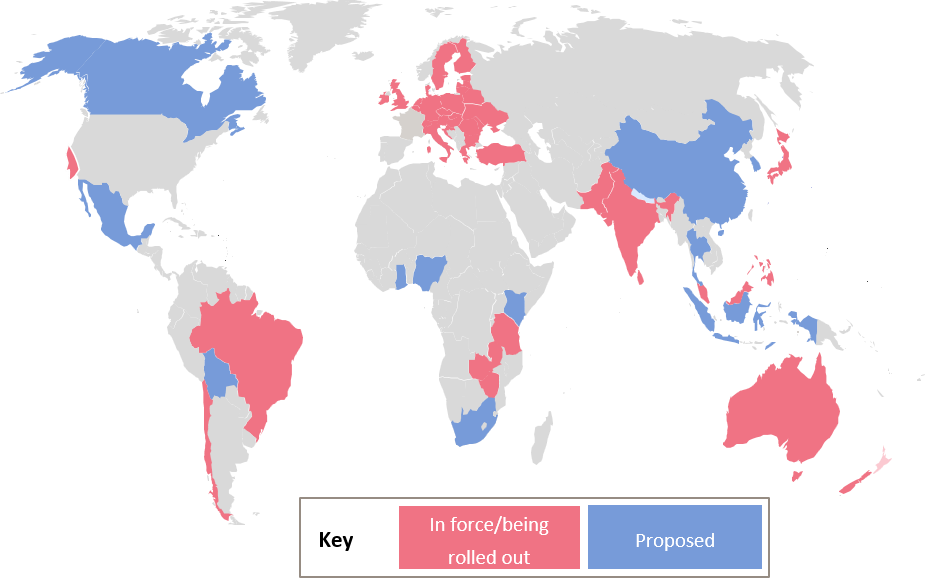
The 2024–2027 period marks a step-change in the prevalence of sustainability regulations worldwide: more than 80 regulations, standards and frameworks will come into force or are scheduled to take effect (Figure 1).1 This shift is significant for digital infrastructure companies because sustainability has become a core compliance and business risk issue, with direct implications for operations, investment decisions and market access.
Figure 1: Active and proposed mandatory sustainability regulations and frameworks, global, as of July 2026
Source: Analysys Mason
The EU remains the most regulated market. It enforces multiple overlapping rules covering sustainability reporting, carbon pricing and due diligence, such as the Corporate Sustainability Reporting Directive (CSRD), the EU Taxonomy and the Corporate Sustainability Due Diligence Directive (CSDDD).
At the same time, similar regulations/frameworks are emerging globally.
- Sustainability Standards Board of Japan (SSBJ). Disclosure standards, aligned with the International Sustainability Standards Board (ISSB), that require large, listed companies (market capitalisation above USD18.7 billion) to report sustainability information. Phased application is expected to begin in March 2027.
- California Climate Disclosure Laws (SB 253 and SB 261). State-level regulations that require large companies doing business in California to disclose greenhouse gas emissions and climate-related financial risks. Reporting requirements started in January 2026 and are phased depending on company size through 2027.
- Australia Climate-related Financial Disclosure (CFRD). Mandatory climate disclosures aligned to Australia’s sustainability standards (ASRS), which are based on ISSB’s International Financial Reporting Standards (IFRS) S1/S2. Phased implementation began in January 2025 for the largest companies, with additional cohorts included between 2026 and 2027.
There is growing convergence in sustainability reporting. More than 40 jurisdictions have adopted, aligned with or referenced the ISSB’s IFRS standards. However, differences in scope, timing and enforcement of these standards creates a complex compliance environment for digital infrastructure companies operating across multiple markets. Meeting these requirements will demand new data collection systems and closer co-ordination across business units and supply chains.
Sustainability regulations are imposing stricter requirements at the product and asset level
More sustainability regulations and frameworks worldwide are moving beyond high-level corporate reporting to set requirements for product design, supplier data and infrastructure asset performance. This shift is visible across several areas.
- Product design requirements. Regulations are becoming more prescriptive across product durability, materials and end of life. For example, France’s Anti‑Waste for a Circular Economy law drives design for repairability by requiring certain devices (laptops and smartphones) to display a repairability score (0 to 10). The EU’s Packaging and Packaging Waste Regulation sets minimum recycled-content requirements, while the Waste Electrical and Electronic Equipment Directive tightens producer responsibility for how electronics are collected, treated and recovered at end of life.
- Product-level data transparency. Emerging frameworks such as digital product passports are driving more detailed product-level sustainability disclosures.2 The EU’s Ecodesign for Sustainable Products Regulation entered into force in July 2024, with delegated measures and product requirements expected to be phased in from 2026 onward. Similarly, the Battery Regulation entered into force in August 2023, with disclosure obligations phased in over time. These rules apply to key digital infrastructure equipment, including network elements (routers, switches, CPE) and power/back-up systems (UPS, BESS), and require vendors to disclose product composition, manufacturing and end-of-life pathways. Similar approaches are developing in South Korea, Japan and China.
- Carbon-based procurement pressures. Carbon pricing is becoming a more visible factor in sourcing decisions. The EU’s Carbon Border Adjustment Mechanism (CBAM), which applied to EU importers from January 2026, placed additional emphasis on the embodied emissions of products and infrastructure.3 Similar measures are expected to be implemented in the UK from January 2027. These mechanisms are placing greater importance on carbon intensity during procurement and supplier selection.
- Asset performance thresholds. Some regulations are now setting hard performance thresholds for individual assets, especially data centres. Germany’s Energy Efficiency Act, which came into force in November 2023, introduces a power usage effectiveness (PUE) ceiling of 1.2 for new data centres from July 2026, while Japan’s revised Energy Conservation Act sets a national average PUE limit of 1.4 by 2030 for existing data centres and a PUE limit of 1.3 for new data centres built from 2029. Operators will need to design and run facilities more efficiently from the outset.
Sustainability requirements are becoming hard constraints on digital infrastructure investment
Sustainability regulations are evolving rapidly from high-level reporting requirements to detailed obligations that are affecting large-scale digital infrastructure investments. Over the next 3 to 5 years, tightening requirements on product carbon, energy intensity and asset efficiency will act as hard constraints on where infrastructure can be deployed and how it is designed. Companies that fail to anticipate these shifts risk delayed projects, higher compliance costs and restricted market access. Consequently, it is critical that investors monitor regulatory developments closely and factor them into infrastructure planning from the outset.
Analysys Mason’s Sustainable Networks programme can assist companies and investors. It tracks sustainability regulations and standards as they emerge, expand and evolve. The programme helps players interpret these changes and prepare for the operational and reporting demands ahead of time. Contact Grace Langham to discuss how emerging sustainability rules could affect your digital infrastructure investments, compliance and deployment strategies.
1 See Analysys Mason’s Sustainability regulations and frameworks tracker.
2 A digital product passport is a digital record linked to a specific product that stores standardised information on its origin, materials, composition, sustainability performance, repairability and end-of-life handling, in order to improve traceability, compliance and circularity throughout the value chain.
3 CBAM is a system to confirm that a price has been paid for the embedded carbon emissions generated in the production of certain goods imported into the EU.
Article (PDF)
Download