
Systems integration capabilities can offer telecoms operators value far beyond standalone revenue growth
06 August 2026 | Research
Article | PDF | Enterprise Services | IT Services | Telecoms
"Operators derive the greatest value from systems integration capabilities when these capabilities complement the wider enterprise proposition."

Enterprise demand for end-to-end ICT solutions is creating new opportunities for operators in systems integration (SI) and managed services, including in new areas such as AI and sovereignty.
However, some operators remain reluctant to invest because SI businesses have different economics from traditional telecoms services, and the standalone revenue from SI units is often quite modest.
Analysys Mason’s recent report Systems integration and managed services for enterprises: effective strategies for telecoms operators highlights that revenue and margin contribution provides only a partial measure of the value of SI capabilities. Operators should evaluate SI investments not only based on their direct financial performance, but also on their contribution to differentiation, cross-selling and the potential to develop new enterprise services.
Operators’ SI units have met with variable financial success as standalone businesses
Only a few operators provide separate financial reporting for their SI-related activities, and the available figures show wide variation in reported revenue growth (Figure 1).
Figure 1: Annual revenue growth for selected operators’ SI and related businesses, FY20251
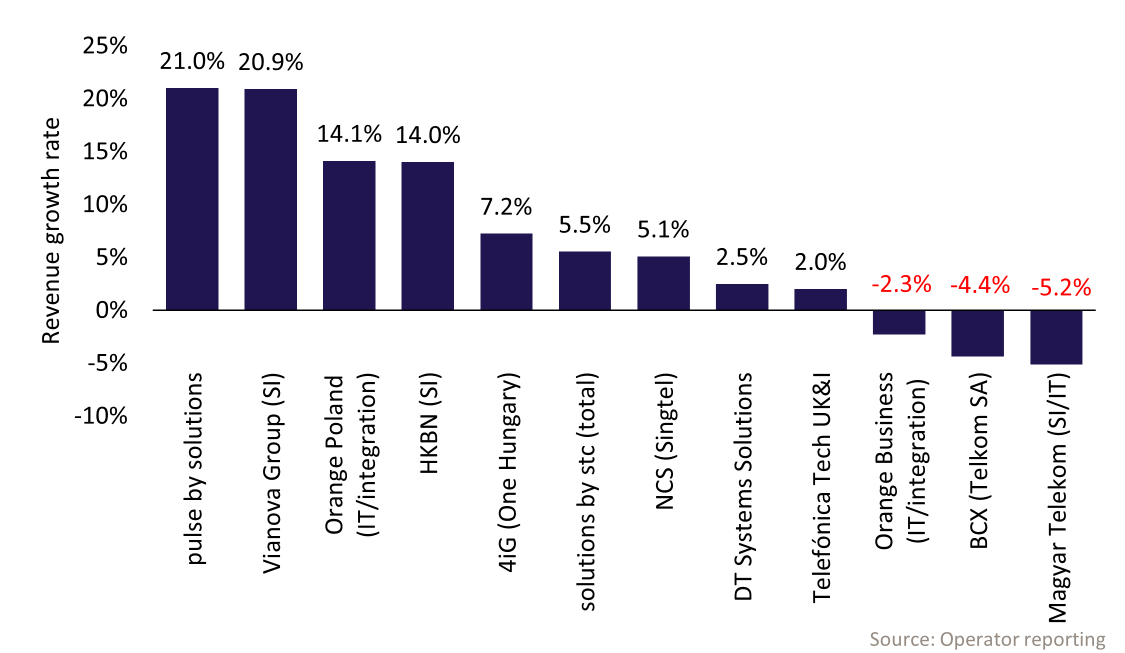
The highest rates of growth in 2025 were reported by pulse by solutions (an SI unit within solutions by stc) and Vianova Group in Italy, whose growth was driven by acquisitions.
Orange Poland’s IT and integration services revenue also grew rapidly, but Orange Business experienced a decline in overall IT and integration services revenue. HKBN does not normally report SI revenue; its 2025 results presented here were unusually good.
Several operators with established SI divisions experienced only slight revenue growth in 2025, and some experienced a decline in revenue.
These modest and sometimes unpredictable rates of revenue growth can make it difficult for operators to justify investment in SI capabilities as a standalone business.
SI capabilities offer significant potential value to operators’ broader enterprise propositions
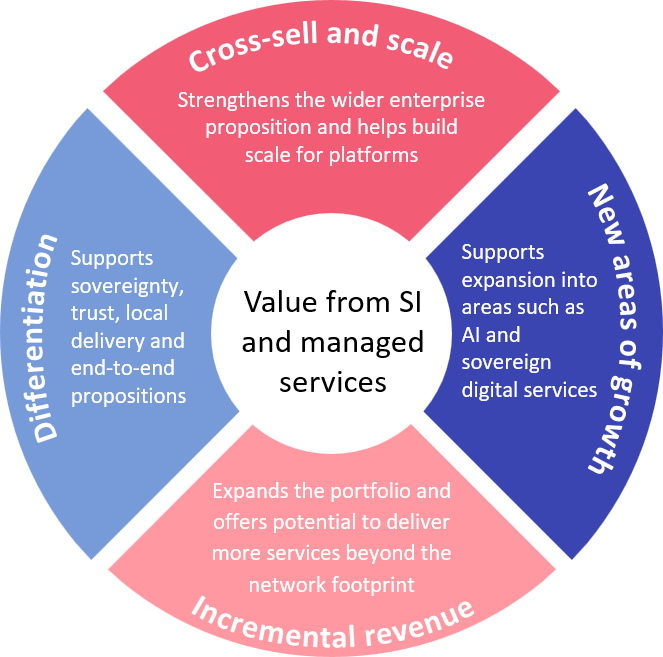
Operators derive the greatest value from SI capabilities when they use these capabilities to complement the wider enterprise proposition (Figure 2). Operators can use SI and managed services to add value to their core portfolio through enhanced differentiation and to cross-sell and build scale for core products and services. They can also use SI capabilities to expand into new areas of growth, developing new services and adding new products to their portfolio. SI and managed services also generate incremental revenue of their own.
Figure 2: Ways in which operators’ SI and managed services capabilities can add value to their enterprise propositions
Source: Analysys Mason
Analysys Mason’s report Systems integration services for enterprises: 10 operator case studies and analysis identifies several examples of operators driving value in this way with their SI capabilities.
- Differentiation. Swisscom has become one of the largest players in the SI and IT infrastructure market in Switzerland by delivering fully integrated end-to-end telecoms, IT and SI services. It considers its SI and IT services business to be a strategically important, profitable and differentiated capability.
- Cross-sell. Telia Cygate reports winning multiple projects across the telecoms and SI space.
- Scale. Orange Business is partnering with SI specialist Tech Mahindra to build scale for its network-as-a-service (NaaS) platform and is using its own SI capabilities to support its cyber-security, AI and other enterprise propositions. BT International is also developing partnerships with SIs to drive scale for its NaaS platform.
- New areas of growth. Deutsche Telekom claims to be one of the largest AI users in Europe. By using the same teams internally and externally, it can bring a strong track record to the market. T-Systems had completed more than 470 AI and data projects by early 2026.
- Generation of incremental revenue. Vianova, an Italian B2B specialist, is increasing its share of customer wallet by acquiring some of the small SIs that it had previously used as channel partners. In addition, pulse by solutions generated strong revenue growth for its SI services in 2025.
The SI business can also be enhanced by the telecoms business. For example, Nexio (Vodacom’s SI arm) operates and manages network and security services for Vodacom as well as selling to end customers through Vodacom. Nexio says that the increased scale means it can bring more business to its OEM partners and command higher levels of certification. Vodacom also acts as a powerful reference customer for Nexio.
Operators should not let the different financial profile of SI divisions deter them from investing in SI capabilities
SI services have fundamentally different economics than traditional, capex-intensive telecoms services. SI divisions are people-intensive and generate lower EBITDA margins but have higher return on capital employed (ROCE) due to their lower capital intensity. Some operators have been reluctant to invest in SI capabilities (and IT services more generally) because of the diluting effect on EBITDA margins. However, comparing SI divisions directly with telecoms divisions in this way risks underinvestment in capabilities that may be strategically important.
SI divisions often make a positive contribution to operators’ cash generation and profit. Indeed, operators such as Telefónica, which operates some of its SI units independently from its telecoms business, still benefit from incremental revenue, product diversification and contribution to profit.
Some of the operators we spoke to for our research also struggle with the volatility of project-based revenue associated with SI businesses. Many aspire to generate an increased share of revenue from recurring managed services. This can be hard to achieve in practice, but there are some promising strategies that operators can follow.
For example, Comcast Business is targeting businesses such as fast-food chains that want repeatable services across multiple locations, and Deutsche Telekom is investing in automation to lower costs.
Operators should evaluate investments in SI capabilities against more than short-term revenue growth or telecoms-level EBITDA margins. The strongest operator strategies for enterprise SI services combine appropriate financial targets for the SI unit with clear mechanisms to create value for the wider enterprise portfolio.
Subscribers can read more on this topic in the reports below, which include profiles of all the operators mentioned in this article:
- Systems integration services for enterprises: 10 operator case studies and analysis
- Systems integration and managed services for enterprises: effective strategies for telecoms operators
Analysys Mason also publishes a wealth of other information and reports relating to IT and telecoms services for enterprises as part of our Enterprise Services programme.
Download
Article (PDF)Author

Catherine Hammond
Research DirectorRelated items
Article
Where will US digital infrastructure capital go next?
Article
Operators must look beyond speed and price to differentiate their business broadband services
Article
Monetisation of the AI value chain must reflect both the benefits of AI and the underlying cost structures